Category: Apraxia client stories

  • Instant connections aren’t a coincidence

    There have been times in my career that I have instantly connected with kids I first meet.  Usually, time is spent building trust and rapport, which would be expected really.  However, there are rare times when the connection is instantaneous.

    The first time this happened to me was with a Kindergarten boy who had apraxia.  He was nonverbal, anxious, and highly sensitive.  I had just come off of maternity leave, and my substitute SLP described him as not having a desire to communicate, but otherwise, she just couldn’t figure him out.

    When I walked into his classroom, he hugged me like he had known me our entire life.  I will never forget it, especially since I discovered he was not this way with ANYONE.  I felt special, and I vowed to make him feel special too.  I documented that experience in my blog post Instant Connection with Ben.

    Yesterday I met a new client who is almost 3 1/2.  I’ll call him Joe. Joe was described in the case history as friendly and social, but I was certainly surprised when I went out to meet him and he jumped into my arms.  His mom was surprised too, wondering who I maybe looked like that he knew.  Yesterday was just the initial evaluation, so I couldn’t really interact playfully with him as much as I would have liked.

    However, it made me think of Ben.  I left for another school after two years of working with Ben.  When I left, he was talking with his peers in mostly simple and some complex sentences. He had found his voice, and I knew he would be okay.  It was still hard to leave him, and his brown eyes looked so sad and worried when I told him he would have  a new speech teacher.  His parents wrote the letter that helped me get into the Apraxia Intensive Training Institute.  It was a handwritten, heartfelt letter in Spanish, and they were so worried that it wasn’t good enough.  I was so excited to tell them I had gotten in.  I always say apraxia is a journey, but it’s also a journey for the treating SLP.  We become so invested, and we frequently don’t get to see the end result.

    So here I start on a new journey with my new instant connection.  I believe instant connections happen for a reason, and I don’t plan on letting Joe down either.


    605772

  • Some kids are just smarter?

    Some kids are just smarter?

    “Well, my brothers have a little bit of a bigger brain, so they are a little bit smarter than me,” declared a second grade student I see who just happens to have apraxia.

    “I don’t believe they are smarter than you, or have a bigger brain than you,” I retorted.  He was so sure though.  Not in a defeated, depressed way.  No, more in a matter of fact, I know more than you way, and he was just so sure.  “My brother has a bigger brain, so that’s why he can build better Lego buildings than I can,” he said.

    “Sweetie, your brother is in SIXTH grade and you are only in SECOND.  Have you ever thought that is why he can build bigger Lego’s than you?”  I argued.

    “No, he’s just smarter.  His brain is bigger,” he replied.

    Sigh.  Where do I start? I can’t let this go.  I’m supposed to be doing speech therapy, but this is too important to brush off.

    “I don’t care what you think, or how you sure you are,” I said, “I don’t believe their brain is bigger than yours.”

    He listened.

    “Sweetie, my husband is super AWESOME at Legos.  He can put them together faster than anyone I have ever met. He is an engineer.  An engineer is a person who tends to be good at math and good at figuring out how things work.  I would make a terrible engineer.  Not only can I not do Legos or figure out how things work, I really don’t care.  You know what I’m good at?  I’m good at talking.  I’m good at writing.  I LOVE words and language.  My husband, you know, the Lego guy?  He doesn’t like writing.  He doesn’t care for words.  So, who is smarter?”

    His eyes got really big.

    “Who is smarter??  Who has the bigger brain??” I demanded.

    “I…I ….don’t know.”

    “Exactly.  No one has a bigger brain.  We are both smart at different things, and you are too.”

    He smiled.  I hope he heard me.  What a tragedy it would be for this child to think he is not smart.  What a tragedy it is for ANY child to think they aren’t smart.  Every child has gifts in different areas, and our job is to make sure they all know it, and they all find it.


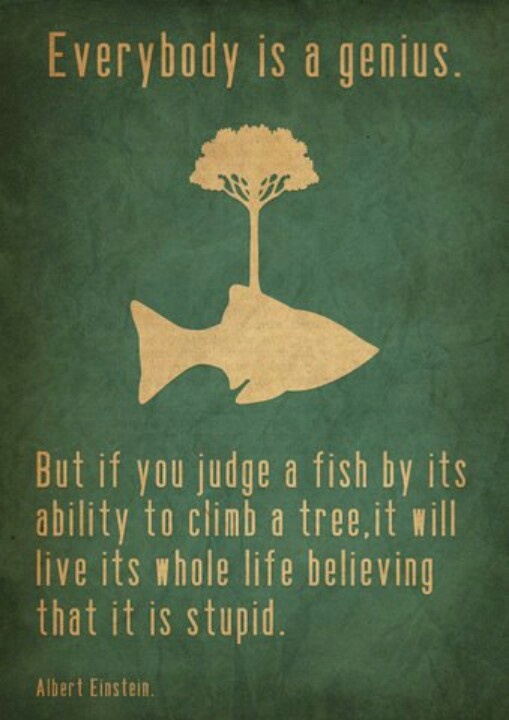
    einstein-quote

  • Why nature weighs more heavily than nurture

    Why nature weighs more heavily than nurture

    Nature versus nurture.  It’s a phrase that comes up in my profession, even if it’s unspoken.  I’m in the business of child language development, and nothing raises more eyebrows about nurture than a child who can’t talk…. or who has poor vocabulary knowledge…… or is lacking in language skills.

    Oh it comes up in psychology too.  We’ve all heard the stories of twins separated at birth and raised in different environments.  How do they turn out?  Are they a product of their environment, or did nature play a bigger part?  I don’t really know the answers to those particular studies except what I’ve seen on talk shows like all of you.

    However, I’m here to talk about speech and language development.   I’m a professional in it, but nothing could have taught me more about nature versus nurture than having two of my own children.

    Maybe that’s why it took me until my daughter with CAS was almost three to get tested.  Was I in denial?  What the heck?  Well,  I’ve seen the eyebrows from fellow colleagues about children I’ve treated.  I’ve been privy to the comments, “well, his parents just never read to him!” or  “they just don’t talk to their children” or “those parents anticipate all of his needs that he has no NEED to talk.”  So yeah, I’m pretty sure THOSE comments were exactly why I waited so long.

    Deep breath.

    Teachers and speech/pathologists, we need to talk.  This talk is cancerous.  If only you KNEW what a parent who has a child with delays goes through on a daily basis, you would instantly take back your words.

    I am a speech/language pathologist, and had been practicing five years prior to the birth of my daughter.  I might have been unknowingly pompous once.  Let’s face it, I was.  I was convinced my first child, my daughter, would come out practically gifted.  Heck, I had a master’s degree in childhood language development and disorders.  If anyone could give their child the upper hand, it was going to be this mama.  I remember when she was very young, maybe a month, I had a red and green light rattle that I would slowly move around her visual field.  I even think I wrote on facebook I was having withdrawals from my job and was just doing some “speech therapy” with my child.

    I remember cooing at her, using “motherese,” talking to her while I went about my activities, and even using baby sign with her paired with visual models each time she went to “eat” “drink” or wanted “more.” I remember locking toys out of reach so she would have to request them, demanding some sort of verbal response before she received anything of interest, and having her use AAC on my iPad. We (I) sang nursery rhymes, sang our ABC’s, and had letters all over the house like in the bathtub and on the fridge.  I read religiously to her EVERY, SINGLE, NIGHT.  She was going to be a prodigy.  I just knew it.

    It pains me to write her whole story in this post.  I have an entire blog for that.  Suffice it to say, things didn’t quite turn out as I had envisioned.  Her SLP mama who knew the tips and tricks didn’t seem to know the key to unlocking her voice, or her other motor skills.  Despite nightly therapy sessions, it seemed I was to be the only SLP on the planet who had a child who couldn’t talk.  Who I couldn’t TEACH to talk.  Despite going to work everyday and helping my students find their voice, my daughter struggled with hers.

    Despite throwing myself in research, attending conference after conference on early intervention, or consulting with my colleagues, my daughter STILL struggled to speak.

    I’ve come a long way in this journey, but let’s just say my guilt and feelings of failure for Ashlynn were so strong that I specialized in the disorder.  I love what I do, and I love CAS, but I thought at least if I were a specialist I could finally and truly say I really did EVERYTHING I could to help her.

    “You’re an SLP” you might be saying.  “I have parents who don’t care like that.”

    Let me just tell you, that your parents are now MY parents and I have treated many kids with CAS….and I can tell you with absolute, positive, and definitive truth, that EVERY mother feels or has felt like me.  They may manifest it in different ways, but isn’t that to be expected?  We are all individuals after all.  However, every mother I have met is worried.  Every mother I have met is a praying woman.  Every mother I have met feels helpless.  I felt helpless and I’m a speech pathologist!!!

    My dear colleagues, I don’t want to get another phone call from a mother in Arizona who has a bubbly voice and seemingly carefree personality, confess that despite every night that she lays her head on her pillow pleading with God that her child gets better and praying it was nothing she did, the SLP told her if she had just read to her daughter more, she would have been in a different position.

    This is not okay.

    If you don’t believe that mother, than believe me.  I have finally come to terms with the fact that nothing I could have done would have made my daughter talk on time.  Please, please, don’t add to that mother’s guilt.  I assure you, she is full to the brim already with it….despite the fact there is nothing she could have done.

    I have another SLP mommy I have met now with a child who has CAS get a note from an SLP that stated,”still remains delayed despite excellent familial support.”

    That statement, seemingly benign, implies that that SLP believes nurture plays more than nature, and she is having a difficult time reconciling such delays that are accounted for….GASP…..an actual disorder.

    Friends, speech and language disorders are your livelihood.  Please stop assuming nurture played more of a part.  My son was born in the midst of my daughter’s diagnosis.  He never received the FRACTION of therapy my daughter did, and he said mama at 8 months old.  He went onto to say and do things that left me speechless.  Not  because I doubted him, but because based on my experience with my daughter with global apraxia, I didn’t have to TEACH him any of it!  Time after time, I shook my head asking him, “how can you say that?” or “how can you do that?  I haven’t taught you that yet!”

    If this journey has taught me anything, it’s that speech and language delays really ARE an actual disorder like we all learned in graduate school; and SLP’s, your role couldn’t be more important.  Please don’t taint it by coming in with an assumption “if only they had…..”

    Come in with the assumption that “they have….and they are spent.”  Please, please be the parent’s champion as much as you are the child’s.

     

    nature vs nurture


  • It’s hard to explain how global apraxia affects so much

    It’s hard to explain how global apraxia affects so much

    We went on a Santa Train again this year at Georgetown Loop Railroad.  Ashlynn has never talked to Santa before.  When she was 3, she cried and clung to her dad for dear life.  When she was 4, we went on a different Santa Train, and though she wasn’t scared, she was too reserved to say anything audible enough for him to hear.

    This year a four year old girl was sitting across from us.  As her parents were asking her what she was going to ask Santa for, she eagerly said she wanted another Elsa doll.

    Ashlynn’s not really into Frozen, or any movie really.  Though each year we try, she just has no desire to sit and watch TV…much less a movie.  As for toys, we took her around a toy store three times leading up for her birthday, and though she was mildly interested, it’s just not like the “kid in a toy store” image that might usually come to mind.

    Fortunately, I have my friend Kim, an SLP who also has a son with global apraxia.  I also have a 7 year old client with it too, and interestingly enough, they all are similar in these areas.  They don’t have an overt interest in movies, TV, or toys.  Why?  I really don’t know.  The toys I think has to do with their struggle to play with toys they would cognitively be interested in, but can’t mainuplate because of the gross and fine motor apraxia.  That happened to her last year when she actually asked for baby clothes but then couldn’t put them on or take them off the baby.   To engage in imaginative play is equally as challenging due to their delayed speech and language skills.  Who knows.

    All I know I I started to feel sad listening to this four year old chatter away about what she wanted….until it was Ashlynn’s turn to sit with Santa.  Though he kept asking her what she wanted, what she wanted was to talk.  She asked him “What’s this?” and “What are you doing?” until he smiled and then moved onto another kid.  As he was walking away, she grabbed me frantically and said, “I need presents!!”

    Smile

    Oh Ashlynn.  That’s my Ashlynn and she’s perfect and in that moment I had nothing to be sad about. All she wanted, all she’s ever wanted is to engage people in conversation, and then as an afterthought she thinks about herself.  Even then though, she had nothing specific.  Just presents.  From the outside I’m sure she looks like a typical 5 year old, and it’s hard to explain just how involved her needs are, or how they affect so much.

    However, today, she asked for presents from Santa Clause just like a typical 5 year old and she will find them waiting for her on Christmas morning.

    from the outside in

  • Why’s he crying? Is it me?

    I started at a new school this year, and since I specialize in CAS, the other SLP in the building gave a second grade student who has Childhood Apraxia of Speech to me.

    Not surprisingly I liked him immediately; just like I liked all the other kids with CAS I’ve had the honor of treating who came before him.

    I’ve only known him for about three months, but he is my buddy. My district’s motto is to inspire every child, and the superintendent wants every employee to pick a new kid each week that they are taking under their wing to inspire to “think, to learn, and to care.”

    I love all my kids on my caseload, by “Eli” has a special place in my heart.

    Still extremely unintelligible in second grade, Eli struggles in reading and writing. He wants to write so bad and has AMAZING ideas, but sadly just can’t sound out words because his output is still so jumbled. I’ve been having him orally tell me stories in tx that I scribe, and then I pull out his target words from there. In our short time, he’s made amazing progress.

    Last week I went to get Eli, but he was working hard and diligently on a writing assignment in a small group with his teacher. I pulled up a chair behind him and watched him work, scribing what I heard him tell his teacher. This, after all, is my end goal. To have him orally tell an intelligible story and then transfer it to paper in his classroom.

    He noticed me 20 minutes in, and we worked on speech related to his class story.

    Suddenly, unexpectedly, Eli started crying uncontrollably!!  I tried to ask him what was wrong, but his little chest heaved heavier.

    The teacher called him over, and could only make out something about “speech.” It seemed obvious the reason he was crying was because of me. 🙁

    It was then time for the class to go to ARTS. I got up to leave, and asked him if he was okay. He was still sobbing. The teacher asked him again what was wrong, and seemed to understand he was worried about not finishing his story because he had to go to speech. However, he wasn’t going to speech, I was in his classroom for this speech session, so it was all very confusing. She assured him other kids didn’t finish their stories either and he will have time to finish.

    She asked me what was wrong because she had NEVER seen him cry, much less like that. I didn’t know and I felt awful. I’m supposed to be his ally, why is he crying?

    He sobbed harder.

    I pulled him quickly into a quiet room to see if I could figure it out.

    “Are you upset at me?” I asked. “Did I embarrass you by being in your class?”

    “No,” he said. He explained he was upset we didn’t finish the story him and I had started in our speech therapy sessions. He has already written two marvelous stories that I have scribed since the beginning of the year; and we are on our third one. I am able to understand his elaborate stories, and then I pick out my target words from there.

    He said he had been waiting to finish that story with me all day, and had wanted to practice speech all day; but since I was in his classroom and then it was time for ARTS, he realized we weren’t going to speech that day, and he was sad.

    Darnit! Stupid apraxia. Poor baby.

    Also, really? He wanted to come to speech that bad??

    Me: “So you’re crying because you wanted to come to speech and write your story, and I spent the time instead in your classroom?”

    Him: “Yes!! I have been waiting all day!!”

    My poor Eli. Stupid apraxia. We’re going to beat this together buddy. I promise.

    As a side note, since I’m new to this district I have to be evaluated a lot to make sure I know what I’m doing. I chose Eli’s session to be my first observation. When I told him the principal was coming to observe, he asked me why. I told him it was to make sure I’m doing my job.

    I’ll never forget his reply.

    “To make sure you’re doing your job?? Can’t she see you’re teaching me how to talk here?”

    🙂 Love him. At that point, even if she couldn’t see I was helping him it wouldn’t have mattered. What mattered, is that he can tell, and that means everything.

    f646f5e713fda1905a715e183276ebca

  • Superhero Brave

    Superhero Brave

    For those of you familiar with my blog, I’ve spoke of “Ben” before. A little boy on my school caseload from a Spanish speaking family who has CAS and is nonverbal. However, IQ testing shows him in the 75th percentile! He’s sooo smart. I met him last year in Kindergarten, and we formed an instant bond.

    His Kindergarten teacher was frustrated that he wouldn’t talk; and I’m not sure if she felt it was a reflection on her, but she really wasn’t that supportive of him.
    This year is different! He has a new teacher and she sees what I see, what I saw. She’s sees a smart, friendly, lovable little boy who wants to talk, but just needs people to believe in him and boost his confidence. Every time I see her she starts a sentence with, “you won’t believe this” or “I LOVE him.” Yesterday she told me she believes this year is going to be HIS year. Starting from the first day when she was going around having kids do introductions, she frowned upon getting to Ben and having the other children speak up and say, “Oh he doesn’t talk.” She immediately stuck up for him, telling the other children yes he did talk and that people talk in different ways. Some use Spanish, some English, some use their hands, some use gestures, and some use devices.
    Ben’s corners of his mouth got just a little bit wider.
    Another day, one of the kids noticed that Ben appeared to be talking to the class frog and remarked, “Look! I think Ben is talking!”
    Her reply?
    “Of course he’s talking! Didn’t I tell you Ben talks?”
    Ben’s chest puffed out just a little bit further.
    And then there was today. The icing on the cake.  I picked him up and she calls me over to brag about an assignment he finished first and attempted to share with the class. Picking up on her hint, I praised him loudly in front of the other children. As we leave the too, a little classmate returning from the bathroom enthusiastically called, “Bye Ben!” Now Ben knows how to say bye with perfect clarity. In fact, he says it to me everyday. He pressed his lips together, but the anxiety was too much and the boy left before Ben uttered a sound. I decided to scratch the lesson plan for that day, and instead I asked him if he knew what brave meant.
    I had him draw a picture of someone he thought was brave and I told him I would do the same. We sat at different tables, and I told him not to peek.
    When he was finished, he drew a picture of Hulk and Captain America. I asked him why they were brave and with a smile he pantomined strength and then pantomined a sword motion. I verified he thought they were brave because they were strong and had swords to which he eagerly nodded his affirmation. I then wrote on the back that Hulk and Captain America are brave because they are strong, have swords, and I added they fight bad guys. He tapped my arm and held up three fingers. I said, “three bad guys?” to which he nodded apparently satisfied.
    He then pointed to my picture. I asked him if he wanted to see mine and he again nodded yes. As he looked at a picture of a little boy with a blue school uniform, he looked at me puzzled. I asked him, “Don’t you know who this is?” Ironically, I had also just happened to also draw him holding a sword fighting a word bubble in his head! What luck!
    “It’s you Ben.”
    His eyes lit up and he pointed to himself incredulously.
    “Yes” I said. “You are my superhero because even though talking is so scary, you still try, and that’s what makes you brave.”
    Now that smile was a full blown grin.
    I went onto tell him I needed him to be even more brave than he already was though. I needed him to be superhero brave when it’s time to talk. We then stapled the pages and walked back to class.

    At the end of the day, the Facebook support group had convinced me to tell his parents about the lesson; and since they only spoke Spanish, I decided to go out with the teacher at dismissal and have her translate. When I walked in the classroom, all the kids were sitting on the carpet with their backpacks on their backs in preparation to go home.  In the middle was Ben, with his backpack on, but our book in his lap. It did mean something to him!  As luck would have it, BOTH parents came to pick him up that day.  As the teacher translated, his mother choked up and gave him a big hug as they left to go home.

    Now his chest was puffed out just about as far as it go!  That’s what superhero brave is all about!