Category: Apraxia client stories

  • Good SLP’s for apraxia are addressing the head in the hands

    Good SLP’s for apraxia are addressing the head in the hands


    Therapy for apraxia is direct and intense.  Any task that involves motor planning is this way.  Motor planning any skill, whether it be learning to shoot hoops, hit a tennis ball, or learning to speak when your etiology is motor planning (apraxia), instruction needs to be intense and involve a lot of repetitive practice.

    I remember when I attended an intensive 4 day training, Dr. Ruth Stoeckel from Mayo clinic was asked how many repetitions SLP’s should be looking to get in therapy.  She hesitated and expressed concern about giving a number.  I didn’t understand her hesitation at the time.  It was a simple question, how many repetitions should we be trying to get in therapy?  We were all professionals.  We all understood that this number would be in the ideal circumstance, and that many factors would decrease the number.  Still, she was hesitant to give a number.  She did finally say in the ideal circumstance, we are looking to get around 200 reps per session.

    I now realize why Dr. Stoeckel was hesitant to throw out that number.  It’s not only because it can only happen in the most ideal circumstances and we might frequently fall short.   The main concern is that a number doesn’t take into account a child’s emotional health.

    Let me say it again.  Yes our goal is to get a lot of reps, but it doesn’t take into account a child’s emotional health!

    I was talking to a student who is Ashlynn’s para right now and he is looking to earn his special education degree.  He expressed concern that others seemed so much smarter than him and he was worried he wouldn’t be as good a teacher.  He was the only person in Ashlynn’s life thus far who recognized her anxiety and nail picking and fixed it by buying her a rubber band ball.  His professor actually admonished him for it.  It just went to show his professor sitting at the university was completely out of touch with what was going on the field, and that was my point to this young man.

    I have met brilliant SLP’s.  Seriously brilliant.  “C’s get degrees” does not apply in my field.  I’m not trying to boast either, it just doesn’t happen.  Graduate school for speech/language pathology is extremely competitive, and average GPA’s, AVERAGE, were 3.88 to 3.97 at the time I was trying to get into graduate school.  That means a fair amount of current SLP’s held college level GPA’s that were 4.0.

    It’s important to have the best of the best teaching our children to talk; however, a GPA can never account for what I would consider to be one of the most important qualities in an SLP.  It’s a quality I can’t even succinctly put into one word, but it is by and far the most important.  It is a therapist’s ability to read and then respond to the emotional health of their student or client.  If we, in our quest to get 200 reps completely disregard any signs of emotional anxiety, distress, or defeat in the child; we have lost everything we had hoped to gain.

    Let me say that again.  If we sacrifice a child’s emotional health for the sake of getting in so many reps, we have lost EVERYTHING.

    Speech therapy is predominately speech and language therapy, but the counseling aspect I believe is significantly underscored. My graduate program did include a class on counseling in speech therapy, but it was geared primarily to the adult population or for those who stutter.  Our pediatric field recognizes now the importance of counseling in stuttering therapy, but there is very little information out there on counseling and our kids with not just apraxia, but also a phonological disorder, articulation disorder, or a language impairment.

    What Dr. Stoeckel was trying to tell us in her hesitation of throwing out a number of reps we should be targeting, is that if we sacrifice their emotional health and our trust relationship with them for the sake of getting in a certain amount of reps, we have sacrificed everything.

    I get sent videos from time to time asking for advice, and usually what I find striking is NOT the speech therapy that is being done, but the absolute blind eye turned to a child’s nonverbal signs of emotional distress.  I remember watching one video and the child was enrolled in PROMPT therapy.  The SLP was kind, competent, and skilled at what she was doing.  What she never even once acknowledged though was that the child would constantly put his head in his hands when she asked him to repeat anything.  Nothing was said.  Nothing at all!  Not, “It’s okay, I know this is hard, but you got this!” or “I know it’s so hard and I can see you are frustrated so let’s take a break.”

    Nothing. Just, “Say it again, try again.”

    It was all about reps and speech and reps and speech and reps and speech and reps and speech.

    I’m here to tell you, if we aren’t addressing the head in the hands, the best and the smartest SLP in the world isn’t going to make progress.  I told this student, if we aren’t addressing the nail picking that causes bleeding, the best and smartest SPED teacher in the world isn’t going to make progress.

    Let’s go back to motor planning though, since the research is telling us that is the most effective form of treatment for apraxia.  If we liken it to another motor skill like basketball, is the job of a coach JUST to teach the kid the right technique and the right form to shoot a basket?  Or, is the job a coach to also encourage, foster, and nourish their confidence as well?  In that analogy, it seems obvious; yet with speech therapy we still don’t seem to be there yet.

    A final example comes from a newer client of mine.  Completely nonverbal at the age of 7, her school SLP, who is amazing, risked her job to recommend private therapy.  After three months, she was making progress, but much, much slower then I wanted.  She had major avoidance behaviors and if she were asked to repeat anything again she would point to something else, pretend her finger hurt, or try to get off topic.  The avoidance behaviors decreased the more she developed trust and had success, but I still felt like I was missing something.
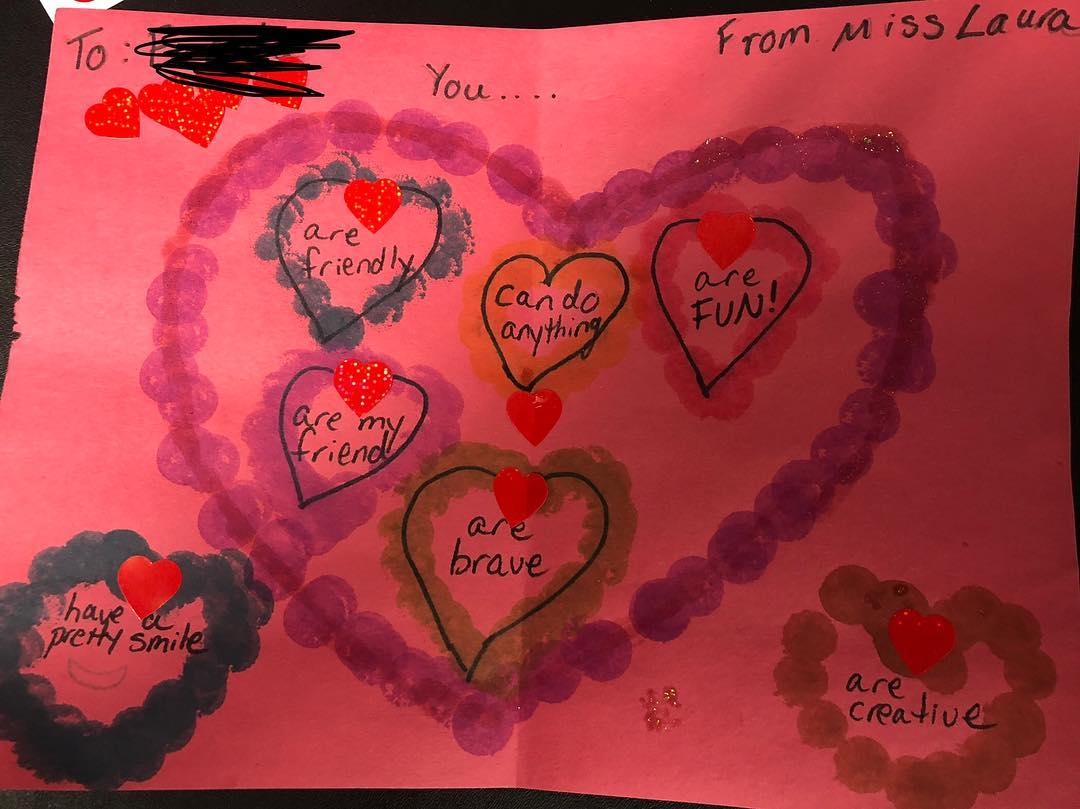
    Since Valentine’s day was coming up, I decided we would take a break from speech and do something fun.  Make Valentine’s.  I still embedded a few target words in the activity, but for the most part, the focus was on the Valentine.  She made one and I made one.  When I showed her mine, I read all the things I wrote about to her.  I stressed that she was brave and could do hard things.  Her brown eyes searched my face, wanting to believe me.  When I read she was creative, she proudly pointed to the Valentine she had made, and I nodded in affirmation.  After the session, I had her mom come in and read it.  She beamed as her mom read the words on the page.  Before she left I looked her in the eye again and told her she was brave and could do hard things.  This time, though her eyes still searched my face, she nodded her head.

    The next day her school SLP sent me a video.  She had a breakthrough and said two new words and her confidence was through the roof.  We both decided taking time to address her emotional health was going to be just as critical to her speech progress as were the principles of motor learning.


    My message today is this.  You can have the smartest, most competent, adept and amazing SLP in the world;  but if they aren’t addressing the head in the hands, the avoidance behaviors, or a child’s emotional heath; they are sacrificing EVERYTHING. In our quest to provide good therapy for apraxia, we keep in mind the principles of motor learning, but ALSO what it means to be a child’s coach and champion.  That might mean some sessions we elicit 0 reps, but what we gain in trust is immeasurable.

    Be the therapist who is looking to give good therapy, but who first and foremost is always looking for and then addresses the head in the hands.  Your kids will thank you.
     

  • and then…there were words!!

    and then…there were words!!

    Almost 1 year ago today, I met a three year old who walked into my office with his mother.  He had been receiving speech therapy since he was in early intervention. He had also been receiving private speech therapy from another office. Despite having no other co-morbid issues, he only had four words: Mama, O, Daddy, More.

    This child was probably one of the best and most adept mimes I have ever met! He had a ton of nonverbal sounds, a lot of jargon, and the most complex gesture system I have ever seen.  He was obviously very smart with no receptive language concerns whatsoever.  I diagnosed him with Childhood Apraxia of Speech that day and we started on a new path for this special little boy.

    Mom or Dad attended each session, and mom kept a target word list in her phone.  Grandma, a caretaker for this boy, came to one session to also learn and observe.

    Almost 7 months of intense therapy, this boy reached a point of therapy where I usually start to see carryover into spontaneous speech.  I waited for a month, but he still refused to try without a model or cues from me first. He largely remained nonverbal.

    I started to get worried. He has NO other problems aside from verbal apraxia.  Why wasn’t he transferring what he could do??  Maybe I should refer him on.  I’m not sure I’m helping him.

    I waited another month.  This was in December and I remember because I told mom I was sure we would start to see carryover soon, and I remember her saying it would be “the best Christmas gift ever.”

    Christmas came and went.  He still wouldn’t talk outside my room.  My heart was sad. I wasn’t helping him.

    I waited another month.  He could imitate everything I said. Actually, he could independently say most of his target words.  Yet he wasn’t. I was so sad I didn’t make good on her Christmas wish. Why wasn’t he doing it anywhere else??  Another month came and went.

    I decided to give him some real “counseling” sessions.  I was talking to a 3, almost 4 year old, and it’s hard to gauge what they understand, especially if they are nonverbal; but I decided to try.

    “Alex.  You have to take a risk.  Do you know what that means?  It means you have to try even though it’s scary.  Even though you think you’re going to get it wrong, you have to try….and Alex, if you JUST try, I promise, I promise,  I will be here to help you if you say it wrong. Okay buddy?  Listen, I can’t  be with you all day and help you talk.  I can only do it here.  The rest is up to you.  You have to be brave.  You have to go out there and try to talk and you might mess up, but that’s okay, okay?  Sometimes we mess up.  It’s okay to mess up, but I need you to try!”

    I said something like this, or the equivalent to this for three sessions straight.  It seemed to be going nowhere…..

    Until…..

    One day…. it did!

    His mom came in with new words he had said on his own that she had saved on her phone.

    “He was at his brother’s soccer game and said, Go Matthew!”

    I smiled so big.  Oh man.  In my profession, it doesn’t get ANY better than that.  He FINALLY took a risk.  He finally transferred all the blood, sweat, and tears he had been practicing with me.

    I shook him. I praised him.  I probably even danced a rain dance.

    “Alex!!!  You TOOK a risk!! You tried to talk without me and LOOK!  You did it!  I KNEW you could do it.  You’re so brave.  I’m so proud of you.”

    The words have kept pouring in after that.  Every session now is something new.  New words and phrases on mom’s phone.  Reports of

    “He’s imitating more”

    “He’s trying to say everything we say”

    “He argued with his brother for the first time ever”

    I live for that moment.  I live for those reports.  One week there were no words, and then one week, all the therapy paid off!

    That doesn’t mean he’s exited from speech.  He isn’t.  There are more sound and sound sequences left to go, but it’s different now.  He and I both know he will achieve them now, and he goes out and tries to say them all without me.  He won’t earn an award for this achievement. Everyone will just see a boy who is talking.  What’s the big deal?

    I’m lucky because I’m also the walk coordinator and I will be able to call his name and put that medal around his neck and award him for all of his hard work.  I will be able to personally tell him I SEE him,  I RESPECT him, and I’m PROUD of him for doing the one thing everyone takes for granted:

    SPEAKING

    Every Child Deserves a Voice


  • It’s rare, so no one cares?  Prevalence of CAS

    It’s rare, so no one cares? Prevalence of CAS

    What’s that?

    If you have a child with CAS (Childhood Apraxia of Speech), you have heard this question once, twice, many, numerous, too many times to count in the course of their life.  We all have developed our standard answer since we are prepared for the fact that no one knows what apraxia is.  This sadly does not just include the general public.  We run into this with doctors, teachers, professionals, and yes, some parents have even reported getting this question from Speech/Language Pathologists!

    I am a self-declared Apraxia Advocate and the reason I’m so passionate about awareness is because with awareness comes proper diagnosis, and only after a proper diagnosis can the child get proper treatment.  Only with proper diagnosis will we understand additional learning difficulties that may arise from this disorder; which means we will be better equipped to understand how they learn differently and tailor their educational programming better to fit their needs.

    We say that CAS is a rare and severe speech disorder.  We convince ourselves people don’t know about apraxia because it’s so rare, and sometimes, I think we all start to accept nothing will change.  Afterall, it only affects 1-2 children in every 1000.

    I certainly have my down moments where I have thought this, but it actually has never deterred me or stopped me from my efforts.  I’m preparing for a presentation in July for the CASANA conference, and something made me look up prevalence rates of other disorders.

    Have you ever heard of Down Syndrome?  Are you reading this thinking what a silly question? I’m willing to bet 99% of you have heard of it.  It’s covered well in graduate school for speech, and usually every school setting has at least one child with DS in the building.  At the very least, most teachers, educators, professionals, and most of all therapists have heard of Down Syndrome.

    Would it surprise you then if I told you the prevalence rates for Down Syndrome are 1-2 children in every 1000 births.  Sound familiar?  Maybe that’s just because I just wrote that figure for CAS.

    I actually started to get worked up.  Wait a minute.  What is wrong with this picture?  That can’t actually be right can it?  I thought to my own personal experiences.  At one school building I have two kids with DS and in a second, I have one.  At one school building I have two kids with apraxia, and at another I have two as well.

    Wait, so how is it EVERYONE it seems has heard of Down Syndrome, but no one ever seems to know what apraxia is?  Oh friends, this bit of data has now only strengthened my resolve.  At one point, somewhere, I’m sure Down Syndrome was a rare disorder too that no one had heard of.  Oh friends, we need to step up our game.  We need to stop accepting that no one will ever know or care about apraxia (oh fess up!  I know we’ve all been there at some point). The it’s rare so no one cares attitude is not acceptable anymore.

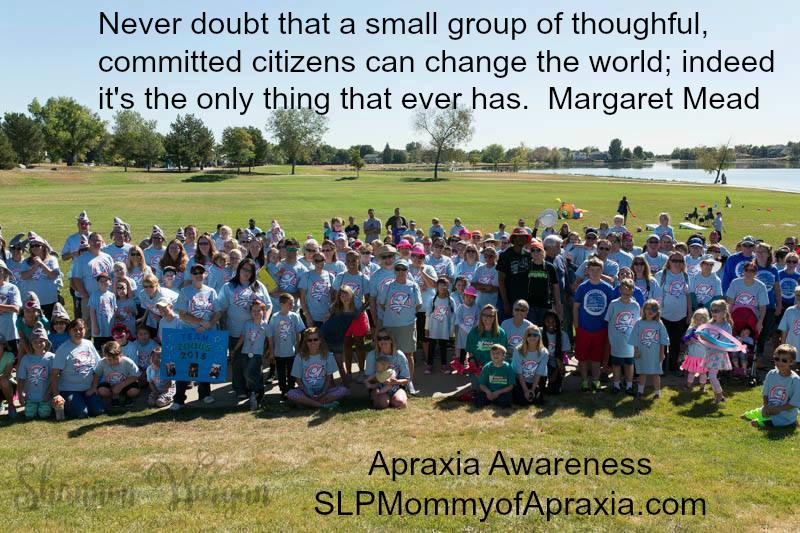
    We have to continue on!  I saw this the other day and absolutely loved it.  I can tell you I know many apraxia walk coordinators nationwide now and we all have this in common.  Every person counts.  Even one more person who knows what apraxia is, is a victory.

    Let’s stop thinking rare=unknown, because it’s not true.  We only need to look at the Down Syndrome Community to prove that point.

    It’s time to make our collective voices louder.  Join your local walk, educate the community around your child; remember, every person counts.  CAS was only accepted as a real and distinct disorder in 2007, which really wasn’t that long ago….but the point to remember is that it IS a real and distinct disorder and our children DESERVE to have professionals in their life who are as familiar with apraxia as they are with Down Syndrome, don’t you think?

  • Apraxia and the village.

    Apraxia and the village.

    I work in the schools a few days along with my private practice work.  I say I work in the schools because I like working in Ashlynn’s school, and that’s partially true.  However, I have always in my career had at least one child on my caseload with apraxia in every school in which I have worked.

    If you have a child with apraxia, you’re probably thinking, “what’s the big deal?”

    If you are an SLP, you might be thinking, “Wow!  I’ve only ever had one, or none, or….”

    Anyway, if you are in the apraxia community, you know about the “apraxia coincidences” and if you know me, you know I don’t believe in coincidences.  So part of me feels like I’m put at a school I am at because I can be of service and have a connection to a particular child, with Ashlynn’s school being no exception.

    Currently I have a 4th grader that I see and I can only say so much because of confidentiality, but I love this boy.  Actually, I wrote about him once.  You can read about it here, but it turns out, I was right.  He’s gifted.

    Ha!  As I went to link that last post, I had actually included this graphic two years ago.  How things come full circle right?

    Anyway, his nonverbal IQ is off the charts and now he’s in the gifted program.  However, he’s a fourth grader and still can’t read or write, such is the extent of his disability.  I can’t imagine being so smart, but being unable to read or write.  Such is his life.

    We have every AT tool at his fingertips.  Technology though still hasn’t totally caught up to the extent of his disability.  His grades remain sub-par, and he is unable (and many times defeated so he’s unwilling) to produce any written work.

    There are sooo many people in this boy’s life who believe in him and who want to help him.  Meeting after meeting takes place behind the scenes.  I’m serious.  If you don’t work in the schools, you have NO idea the mobilization and time occurring on behalf of our children.  I know his parents don’t.

    Anyway, after at least two major meeting of the minds with every professional expertise (OT, Speech, SPED, gen ed, ATRT specialist, TA), we finally came up with a plan we thought will help him become more independent with his school work regardless of current reading, writing, or spelling ability.

    We set a meeting date of today with ALL of these above listed professionals and the child.

    Let me take a quick digression.

    A week ago, I posted on my SLP Mommy of Apraxia/Dyspraxia Fb page that the librarian at the school stopped me to show me this book called “Fish in a Tree.”  The book is written by a woman who had dyslexia as a child, and writes a fictional novel based on real life events about her life and the people in it.

    The librarian read this one chapter to me the other week, in which the girl’s teacher listed famous minds of our past and current generation.  They all were brilliant, but as it turned out, they were all believed to have had dyslexia.  I was so inspired.  I couldn’t WAIT to read it to my 4th grader.  The librarian was going to read it aloud to the entire class during library time, but she wanted me to read it to this child first so he knew we were all thinking of him.

    Today I got the chance.  I asked him if he knew the names of the people and what they were famous for.  He didn’t disappoint.  He can’t read, but he knew most of them as I read them to him:

    Thomas Edison? – “Invented the light bulb”

    Alexander Graham Bell?  – “Invented the telephone”

    Albert Einstein? – “Really, really, really smart.” 🙂

    Walt Disney? – “Made Pluto!”

    The list went on, and as I read the pages to him, some he knew and some he didn’t, I swear I could see a spark glow in his eyes and it was everything I could do not to cry.  People, this boy is as brilliant as all these people I was reading to him.  I honestly believe that, and it’s not just me….EVERY professional who works with him feels the same way; but if  you can’t read, and you can’t write and you’re in the fourth grade, you don’t feel that way.

    I barely got through reading the entire thing without completely breaking down.  When I finished there were stars in his eyes.  I’m telling you.  Bright, bright stars, and he smiled as he said, “Wait, all those people were like me!  They couldn’t read, but they were super smart and they invented stuff BECAUSE they weren’t typical.”

    I nodded my head.  That may not be a completely accurate assessment but I sure wasn’t going to contradict it, would you?  Oh, and I should mention, his comment came after a therapy session we had a few weeks ago in which I showed him Mikey from Mikey’s Wish who was talking about “neurotypical” and “neurodiverse.”  I knew he was alluding to this because he was inspired by the idea of being “neurodiverse.” (Thanks Mikey).

    As fate or coincidence would have it (coincidences aren’t coincidences), let me take you back to the meeting of all the professionals, the village, that helps this 4th grade student.  We scheduled another meeting, this time to include him.  It just happened to be that it was right after I read him those excerpts on these brilliant minds needing to find another way to express themselves.

    I took him to class where the meeting was about to take place, and his awesome 4th grade science and math teacher, who had already prepped him (for being in such a daunting meeting by himself with so many adults) told him we are here because we believe in him, and sometimes great minds have to find another path to greatness.

    His eyes lit up.  “Like Albert Einstein, and Disney, and the guy who invented the telephone!”

    People, the tears were in full force behind my eyes, but I still didn’t let them go.

    As the entire special education and general education team piled in, I watched this incredible strong and resilient 9 year old, listen to the plan set before him.  He was surrounded by people who loved him, but still.  He was outnumbered by 1:9 and he listened to our plan on how to help him read and write using technology, and, get this….his VOICE.   Yes, his VOICE would be a huge part in his written output via voice memo, and that’s possible, because he has one.

    We are all under no illusions.  We know this will be hard for him.  We know he will be frustrated and maybe even resist.  But literally, 8/9 people at that table believe he is capable (the 1 out-liar being him), and as one of his reading specialists said, “Maybe he doesn’t believe he can do this, but hopefully he will remember all the adults who think he can and it will keep him moving forward.”

    I was so proud to be sitting there as part of his team….his village; because we all know, these kids need a village.  I was trying pretty hard to reign in my emotions.  I thought about how lucky Ashlynn is to have this village too.  I don’t need doubters in her corner, I need believers; and I really know we have that.

    Oh, and about my 4th grader.  Believe me when I tell you he has BIG ideas.  His ideas cannot be adequately explained through his reading, his writing, or even his voice. I predict one day these BIG ideas will be turn into something even bigger.  I look forward to seeing it.


  • The decline of the therapeutic relationship and why you don’t have to stand for it.

    The decline of the therapeutic relationship and why you don’t have to stand for it.

    I’ve noticed something since I’ve had my daughter in therapy.  Therapy offices that are small, with only a couple therapists and an actively involved owner, yield happy clients.  Conversely, therapy offices only interested in expanding their brand, that staff numerous therapists and have a relatively un-involved owner, have more unhappy clients.

    I used to work at a place this happened actually.  The owner was fantastic.  Smart, personable and caring, her clients improved, her families were happy, and her reputation grew.  Soon, she was staffing multiple therapists from two different disciplines and opened up a second location.  She became  stretched so thin, that she outlined a list of policies and procedures, and then delegated a supervisor and receptionist to enforcing them.  The result?  Common sense flies out the window.  The parent/therapist relationship becomes strained.  People leave.  I know personally now why this happened.

    Recently I was on the receiving end of this.  I took my daughter to what was supposed to be a well reputed therapy place in Denver, Amaryllis Therapy Network in the Highlands.  I wasn’t too pleased with the evaluation, because Ashlynn has been evaluated three times before with the very same test and this time she scored 20 points lower.  20??  I had to ask myself if that was really accurate and I had quite a long conversation with the therapist who said attention could have played a factor or this or that.  Ok.  Fine.

    However, then she was transferred to a different OT for treatment.  They initially wanted to have her see an assistant.  I have no problems with assistants.  I used to be an SLPA (which is an SLP assistant) and an assistant is more than capable of doing therapy.  However, what they are not able to do, no let me correct that, what they are not allowed to do,  is  change a treatment plan when they see something isn’t working.  They are required to consult with the supervising therapist who IS qualified to develop treatment plans before they change it, and that’s just assuming you have an assistant who is experienced enough to know it needs changing.  Anyway,   I needed someone who can change a treatment mid session if they see something is or isn’t working.  My daughter is not a typical case.  She’s involved and I don’t want to waste time.  I’m not trying to sound rude, but it’s just the way it is.  As a side note though, it does make we wonder how many parents reading this even know if their child is seeing an SLPA or a CODA.  If they are, just know that you want to make sure a supervising therapist is really staying on top of things in regard to your child’s treatment approach…just sayin.

    Anyway, they complied, and I was given a different OT.  I wanted a conference call set up between the new OT, me, and Ashlynn’s school OT who is also my colleague, a therapist I trust, and has been with Ashlynn since preschool.  When she called, it was clear she had not thoroughly read Ashlynn’s report and then mentioned how Ashlynn had done a “group” therapy.

    I’m sorry what? Group therapy?  Ashlynn can get group therapy in school.  I’m paying for private therapy.  I need INTENSE private therapy.  She quickly reassured me it was still 1:1 kid to therapist just participating in a group activity.  Ok…maybe….but that’s not what I was paying for which even furthered my resolve that we needed a group conference call.  I asked if she would email me and she agreed to set up a time.  I NEVER received an email.

    I’m reasonable.  Ok.  Maybe she entered my email address wrong?  I call the next week before another session has come and gone and tell the receptionist I never received an email, would she email me again.  She check the email address on file.  It’s correct.  Hmm.  Okay.  She’ll send another one.  Perfect, thanks.

    ANOTHER week goes by.  NO email.  My husband is the one that takes Ashlynn so I can’t just bring it up.  I’m pretty ticked about this to be honest, but it can still be dealt with…worked through.  Probably an honest mistake.  However, I’m going out of town and I don’t think I can make the carpool arrangements work to get Ashlynn there this week.

    Now, yes.  I know I signed  48 HOUR cancellation policy paper.  I actually remember signing it because it struck me as outrageous.  Who has a 48 hour cancellation policy?  Oh well.  There are people who do chronically abuse the system, and cancellation policies are in place to protect and respect the therapist’s time.  I get that….not only because I just get that…but because I AM A THERAPIST WHO DOES THIS EXACT SAME THING AS A JOB.

    Dang!  Why is that in caps you ask? Well, it’s because even when therapists, or doctors, or people in a field where they are to care about people have a cancellation policy, it’s usually only enforced to the chronic problem clients.  Any person with a heart and common sense, understands that things come up.  If someone is abusing the system, then yes.  A cancellation policy should be enforced.  I was NOT abusing the system.  I called 30 hours in advance, choosing to wait until the morning instead of the hour they closed.

    This was my first time cancelling, we aren’t late, and my husband probably spends close to 3 hours round trip getting her down there through rush hour traffic and back home. Not to mention the financial hardships families are already going through. You would think someone who actually has a heart and interest in caring about children would have been understanding. I know I am! I don’t even have my clients sign a cancellation fee policy, and if I did…I would give them chances. Unbelievable and SO sad. It’s not right we go through this when we are already bled dry from the cost of therapy. So now, I have to find a NEW place and begin the process again.

    Oh, and one more thing. The email situation?  The supervisor said it was documented she emailed me twice.  “Maybe I didn’t get it due to spam filters?”  I went along with it.  Afterall, I hadn’t yet checked spam, even though it’s ironic that I DO get all of THEIR spam email.  Well, low and behold I DID check, and by check I mean SCOUR my spam email and there was nothing.  NOTHING.  NO email from her…so now on top of it I can add lying.

    Anyway, I digress.  I have to find a new place and begin the process again.

    Oh…but I WILL begin it again, because I know there are places and therapists who do not feel the need to run their therapy office like a corporation and treat people, actual human beings, as only dollar signs.  I know, because I’m one of those people, and I know many, many other good therapists who are ALSO one of those people.

    My message to any parent reading, is if you feel like your child and your appointments are nothing but a dollar sign, then you need to leave.  That is so unacceptable.

    My message to any professional reading this, is you need to know and understand we are counting on you! We are putting our faith and literally our children’s success and outcomes in your hands.  Meet us halfway. We are your paycheck, but we are also human.  If you are a person running a therapy office like a corporation, take heed.  YOU may be an honest and awesome therapist, but don’t get caught in some black and white policy and procedures BS.  These are humans, humans with disabilities no less, that you are dealing with.  Have some freaking compassion beyond your rules and regulations.

    Oh, and for anyone considering Amaryllis Therapy Network in Denver, scratch them off your list and move on.  Developmental Fx is where I’m headed, and unlike Amaryllis, I know many families who have been happy with the outcome.

  • Our kids need to meet others just like them.

    Our kids need to meet others just like them.

    This 4th Annual Apraxia Awareness day (it was trending, did you hear?), I organized a fundraiser at a local Chipotle to benefit the Walk for Childhood Apraxia of Speech.  I have a HUGE goal of 30K.  The walk last year made 16K, so basically I set this goal to double that.

    I’m probably crazy, but I set that goal with good reason.  That number ensures a visit for a free parent seminar given by the executive director of apraxia-kids.org (CASANA).  I was the lucky recipient of her visit one year and it was amazing.  The previous walk coordinators had amazing connections and one coordinator raised thousands of dollars just from his connections.  I don’t have anywhere near those connections, so I’m trying to do more fundraising activities to help raise money and get us closer to our goal.

    We had a really good turnout yesterday, with around 50-60 people gathering in South Denver.  One mom even drove close to an hour and half to be there, because she wanted to meet other parents in her shoes going through the same thing.  Social media has made it so we can connect with other parents and families, but of course, there is something different to have a face to face connection with a person who truly “gets” you.

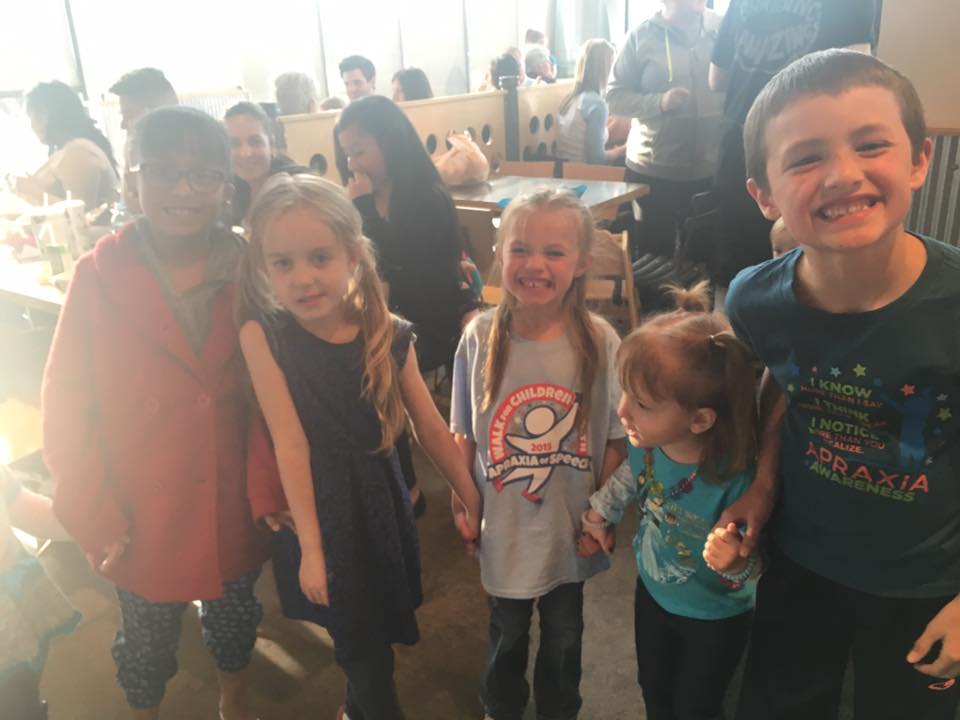
    Last night was interesting, because the kids with apraxia seemed to become instantaneous friends.  You could honestly not help but notice them gravitate to each other and form an immediate kinship.  They were holding hands and had created their own “walk for apraxia” by walking continuous circles around the tables. There was chatter, but there was more laughter, smiles, and pure happiness.

    13178924_10207483206930910_8066579104130304150_n
    Ashlynn holding the 2016 Colorado Proclamation declaring May 14th Apraxia Awareness Day in Colorado

    I was surprised to see a bossy side to my daughter Ashlynn.  Most girls her age have a bossy side, but Ashlynn is always the follower at school.  She has friends and is well-liked, but she is far from being a leader.  You wouldn’t have known it last night.  She was telling people to hold this hand and to walk this way.  She was sweet and smiling of course, but still bossy.  I told one young client of mine to tell her stop being so bossy.  He looked at her and told her “no” through a smile, and she laughed and moved on, only to return again requesting him to follow her.

    The mother of a second grade client came up to me and told me that her son listened attentively to all of the kids and had a look on his face that seemed to say “ohhhh, I get it.”

    And that’s when it dawned on me.  Here we all were, parents, networking with other parents.  Happy to talk and chat to others going through similar experiences.  An instant friendship is formed between the parents.  Without saying anything, everyone seems to understand you so perfectly, and I realized…as I watched smiling face after smiling face, and small hand locking another small hand……that the KIDS had formed their instant connections too.

    A famous actress Gage GoLightly shared a facebook post spreading apraxia awareness thanks to my friend and fellow apraxia advocate Michelle Leigh who discovered it on wikipedia and succeeded in bending her ear.  Anyway, her post outlined how she grew up with apraxia and dyspraxia, but implored people:

    If you know someone in school, or work who has apraxia, or dyspraxia- make today the day to reach out and just talk to them. Underneath everything in the end we are all just people. We all have our unique challenges and special qualities that make everyone incredible. Love and acceptance are what make this world beautiful. Reach out and be apart of the beauty.

    I realized it’s important these kids meet other kids with apraxia.  That they not only meet them, but get a chance to interact with them.  We need it, why wouldn’t they?  I love a quote by C.S. Lewis I reference frequently in my apraxia journey:

    friendship-is-born-at-that-moment-when-one-person-says-to-another-what-you-too-i-thought-i-was-the-only-one

    No one could deny the instant connection these children had.  lt made me realize they need to get more opportunities to meet others who have the same disability.  It was absolutely beautiful to witness.  I wish I had taken more pictures.  I probably only captured a third of the kids holding hands with each other.

    13174133_10207483211571026_2836952414490607233_n

    I’m urging you all for so many different reasons to get out and support the walk, go to the walk, and participate in the fundraisers.  It’s for so much more than raising money.  If you don’t believe me, just look at the smile on your child’s face when they can also finally meet another and say without words, “me too.”  As Gage said, “reach out and be part of the beauty.”