Hi readers! Not only another year, but another decade is coming to a close! My daughter Ashlynn was born in 2009, and it’s astounding all of the changes that set off in my life throughout the past ten years! This past decade was one of joy as a I built my family, but also sorrow facing numerous challenges with Ashlynn.
I have faith though that this next decade will be one of overcoming! I know ten years from now I’m going to be writing another success and triumph story, much like I did in the book I published this year called “Overcoming Apraxia.” I also want this next decade to be one of exponential growth in apraxia awareness and information so all children have the access to the best therapy.
I’ve been on this special needs journey with Ashlynn for a long time now.
I have grieved, recovered, grieved, and recovered again. I have developed thick skin. I have felt guilt, then peace, more guilt, and then peace.
I thought I was past all the BS. I have accepted Ashlynn has severe needs. I have accepted my journey with Ashlynn is going to be MUCH longer than I ever anticipated and I have embraced it. This girl goes to school from 8 to 2:45, and almost every day after school she has some sort of therapy or tutoring strategically scheduled to help her overcome all of her learning disabilities.
I’ve been done making excuses for not doing homework.
I finally just started being honest and saying “We will see. She is a very busy and overscheduled little girl,” when therapists would ask about homework . Ashlynn goes to school and then has therapies after school, and then we hope to get home to eat and then finally do her SCHOOL homework.
That doesn’t mean there isn’t any other homework. Oh no. For all the therapies she receives after school there is also homework. Always homework. So not only does the average kid NOT go to therapy or tutoring everyday after school, they also then don’t have the homework assignments from said appointments after school.
My daughter has it all.
Go to school and get homework, and then attend therapy and tutoring that takes away from homework time after school and receive MORE homework on top of school homework for the extra after school services. Oh, and my daughter has global motor planning issues, so any homework assigned is usually homework that needs to be done everyday.
Everyday my daughter is expected to do regular school homework and then follow through homework for OT, PT, Speech and tutoring as well.
If for some reason said homework isn’t done or done to the fidelity of a therapist’s expectations, I get to see the raised eyebrows and judgemental eyes. I know what they are thinking even if they don’t say it. “You couldn’t carve out 5 minutes for some simple yoga poses? Speech word practice? Sight word drills?”
Again, I thought I was past this. I was done feeling guilt. My whole life is running around trying to get my daughter the help she needs and then coming home and trying to be a mom and get dinner and then at least getting through her school homework. I have been done for a LONG time apologizing for not getting the therapy homework done.
That was until today
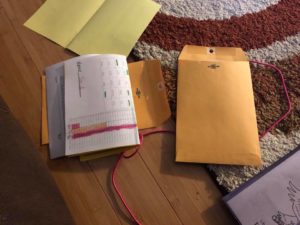
Two weeks ago I put Ashlynn into a therapy called oral facial myology to help with her mouth breathing, tongue thrust and immature swallow. I knew going into this the homework component was going to be big. I knew this! We received a sticker chart to keep us honest. Ideally she would do the exercises 2x – 3x a day and we would reconvene in 10 days.
Today was our second follow-up appointment. I was so proud of Ashlynn! We had done the exercises every single day! A handful of days we managed 3x, most days we did 2x a day, and on three days including one where she spent the night at her grandma’s we did 1x a day.
I was proud of us. That was no easy feat. Sometimes it cut into bedtime but I knew this was important and I was willing to go the extra mile.
My sails were immediately shredded within 5 minutes of our second visit.
The swallowing therapist was warm and inviting as usual. We were seven minutes late because we were driving from PT and I had forgotten to ask the physical therapist to end 5 minutes before and instead she ended 5 minutes late. We still made it though! School ended at 2:45, we were at PT at 3:30 and then we were at swallowing therapy at 4:25. I was proud of myself for getting her to all these places.
“How did the homework go? Did you complete it?” the therapist asked Ashlynn. Ashlynn enthusiastically nodded yes as I took out the sticker chart and the therapist looked on disapprovingly. So there are three days here you could only do one practice session? For this program to be successful, she needs to be doing the exercises at least 2x a day.
“There are a couple days we did three! Does that cancel out the three days we could only fit in one?” I laughed nervously.
I looked up to a face of disapproval.
“For this program to work, you really need to be more consistent,” she lectured.
I swallowed a big swallow and collected our things. I think I literally gulped back tears. I was paying a lot of money for this therapy. Of course I wanted to see it be successful. Of course I wanted to practice with Ashlynn as much as I could. Guess what though? I also needed to make sure we completed her homework and read at least 10 minutes per night. Then and only then did I need to make sure she was doing her homework for reading tutoring, OT, PT, and speech as well. Oh and she also needed to eat at some point and take a shower. Being a kid? Nope. That’s not in the cards apparently.
The guilt and responsibility is overwhelming
I cried as I left the swallowing woman’s office. I was trying! I thought Ashlynn and I had done amazing! We practiced what seemed like every spare minute we had together, which actually is very little spare time together! I was proud of our dedication, but this woman had only criticism. She told me if the program was to work, I really needed to get more serious about practice.
I went home that night in a state of anger.
I was yelling at my kids, my husband, the computer..really anyone who would listen. I was devastated at having a therapist, a well respected therapist basically tell me if I didn’t take the homework seriously and with the fidelity it needed to be, my child wouldn’t improve.
I railed against everyone and then I messaged an ally.
The ally I messaged is an SLP who specializes in apraxia and oral facial myology. I was so lucky to meet her at L.A.’s Walk to Talk for Apraxia when I took Ashlynn at 8 years old. Her name is Lisa Klein and she has a reputation for not only being an amazing therapist, but being an incredible friend, mentor, and encourager. I barely know her yet knew I needed to talk to her. Fortunately for me, she told me I could call her on my way home and like a crazy mom who is desperate I did. I talked in a long winded series of run on sentences and questions and when I stopped she said the most impactful thing to me that brought me to tears.
Laura, first of all, you are a great mom and that girl has come so far because of you.
I started balling. Not like crying either or tearing up. No. Chest heaving ugly cry balling. I just needed that validation. She went onto say things that our myofunctional therapist suggested too like going every other week. She brainstormed how to get in practice or what exercises we absolutely couldn’t miss. She said all of this though with compassion and free from judgement, and that is exactly the type of therapist I aim to be too. We need to meet parents where they are at and we need to know parents are under an insane amount of pressure and are doing the best they can with the tools that they have. I need a therapist to understand that. I’m constantly shocked by the number of therapists who have so most judgement. I say this all the time but I say it again. Please, if you are a therapist reading this please have compassion and understanding for the parents. We are fighting daily battles and crying tears no one ever sees. Please be kind. Please.
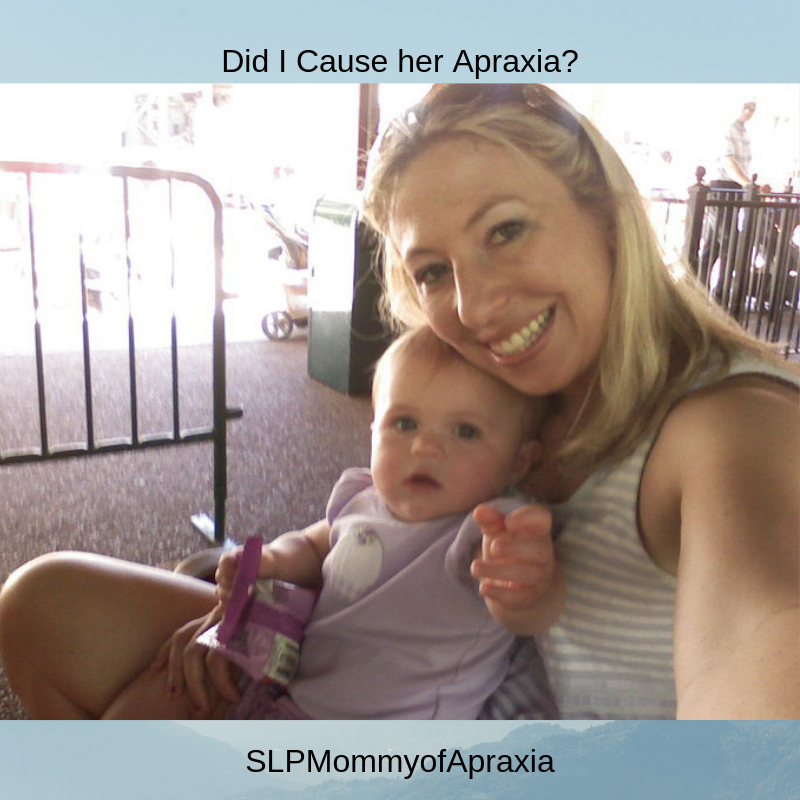
When Ashlynn was first diagnosed with Childhood Apraxia of Speech, I think most parents will relate when I say I spent (pointless) hours wondering what had caused it.
Back in 2012 when Ashlynn was diagnosed, the most current information we had at the time was that it could have three main causes:
Brain Trauma such as a stroke in utero
Genetic causes
Idiopathic – meaning of no known cause
Though I knew this, I couldn’t help but cycle back to questions. Questions that kept me up at night. Any parent of a child with special needs has probably done this endlessly. It is probably one of the main causes of sleep deprivation in special needs parents right behind “am I doing enough? and goes something like this.
Was it that time when I was 6 months pregnant and I had the stomach flu? Did I wear the painting mask long enough when I painted her baby room? Was it because I had to have a C-Section? What about the vaccines, giving her Tylenol, or that time she bumped her head? Maybe it was……..
And before I know it, I’m deep into the weeds unable to find my way out.
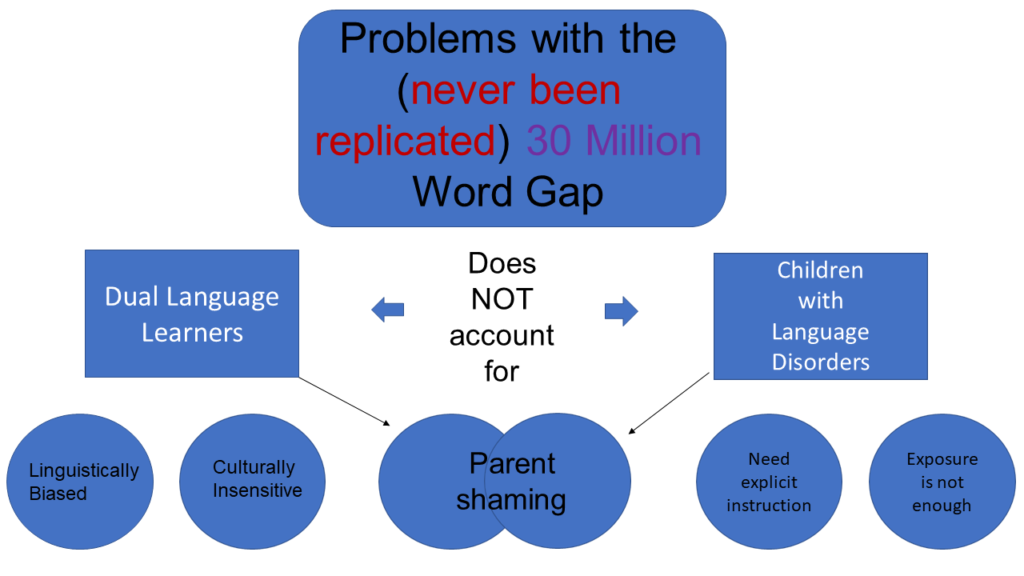
It doesn’t help I had been privy to professional “inside” comments with colleagues who blamed parents for lack of reading, lack of talking, lack of stimulation etc. You can read about my snub to those “opinions” in my article where I snub the 30 million word gap theory.
No answers that is, until we found ourselves in the office of a genetic doctor and genetic counselor. This is not to be confused with general genetic testing that a pediatrician can order either. It was there that we would learn the cause of everything. It was there, I would finally know why Ashlynn had apraxia, dyspraxia, hyptonia, ADHD, dysarthria, SPD, CP, and learning disabilities. The answer was housed in a small set of letter and number combinations called:
BCL11A
A quick pub med article revealed that of the few case studies we have, children shared commonalities with:
Non-verbal or low verbal status
Abnormal muscle tone
Gross motor delays
Childhood Apraxia of Speech
Dysarthria
Hypotonia
Dyslexia susceptibility
The doctor explained the genetic mutation was “de novo” meaning it was not inherited and happened at conception. It was a complete fluke when the sperm and egg came together that this mutation happened on the 2nd chromosome.
Is it possible to be completely stunned and then not surprised at all at the same time? Is there a word for that? If there is, that is how I felt. I knew as a professional researching this endlessly it wasn’t my fault. Mom guilt though. Mom guilt is a real thing. It is strong, irrational, and overwhelming. So, in that sense, I wasn’t surprised.
Knowing though that a genetic mutation was the single cause for all of her disabilities was shocking, but then quickly reaffirming. So many things went through my mind with the biggest one being,
“This really wasn’t my fault, and furthermore, there is nothing more I could have done to change this.”
The genetic landscape regarding apraxia is a new and quickly changing field. We are going to see more research and information coming out now recommending that genetic testing be pursued. Look for a follow up post with me talking about this new and changing frontier.
For now though, I need time to process and learn. A mother does better research than the FBI after all, when searching for answers about their child.
Laura is a speech/language pathologist specializing in Childhood Apraxia of Speech and mom to two amazing children, one neurotypical and one neurodiverse. Laura is a speaker, writer, Denver Walk Coordinator for Apraxia, and is the voice behind the website SLPMommyofApraxia where she is passionate about Apraxia Awareness.
Hi readers! I haven’t been as active on the blog as usual because my goal for 2018 was to write a book and I’m happy to say I completed that goal! My goal of 2019 is for it to be published, so we will see! In the meantime, I did manage to get some blogging done and here are my top 10 posts for 2018! Thank you so much for your support and your love throughout the years. It truly means so much.
Cheers to an eventful 2018. It was a year full of pain and happiness, love and sorrow, and hope and despair. May we all remember that life can be intensely beautiful and irreparably sad all at once, because that my friends, is the definition of living.
This 2019, I wish you all the gift of perspective in life. We all have bad things happen. We all have stress and we all have pain. We also all have a choice, and that choice is to wake up each morning with a grateful heart and to focus on our happy and joyful moments rather than be sucked into the pain of despair and heartache. There was a time Ashlynn’s dx seemed like the darkest event in my life, but I realized it was the beginning of my testimony to some of the most beautiful characteristics this human life affords us. May God bless us all this year and always.
Love and Peace,
Neurodiversity and learning disability were never in my vocabulary before I had my daughter.
I had never been exposed to learning disabilities of any kind really, and I had no idea the extraordinary gifts those who are neurodiverse had to offer this world.
No, when I was in second grade, I was in my egocentric world and our teacher had us write “a book.” It was a short story and we were to write on the typical school paper that has a box at the top to draw an illustration and then lines at the bottom to write the story. Writing was always my thing. Art….was……not. I usually skipped the picture and went straight to writing. In my defense though, I never technically had an art teacher. However, even if I had, I’m sure I would have still been that defiant snotty little girl who turned up her nose at art.
During one edit, the teacher told me the book was great but I needed illustrations. I argued with her. Her job wasn’t to teach me how to draw, her job was to teach me how to write. Drawing was for the kids who didn’t know how to write and I knew how, so what did it matter anymore? Did I mention I also went to a Catholic school, so I was marked down automatically for being sassy? I never pulled that again, but it didn’t stop me from internally rebelling against drawing.
“When will I EVER need to know how to draw as an adult?” I indignantly exclaimed to my mom.
My Catholic school teacher had the last laugh though when I became a speech/language pathologist and discovered I needed to know something I didn’t know how to do. You guessed it. Draw.
“What is that? Is that a dinosaur?” one kid would ask of my drawing of a horse.
“That’s supposed to be a bird?” another asked of my drawing of an airplane.
Yes friends. That sassy, know it all second grade girl started wishing she had paid more attention to art.
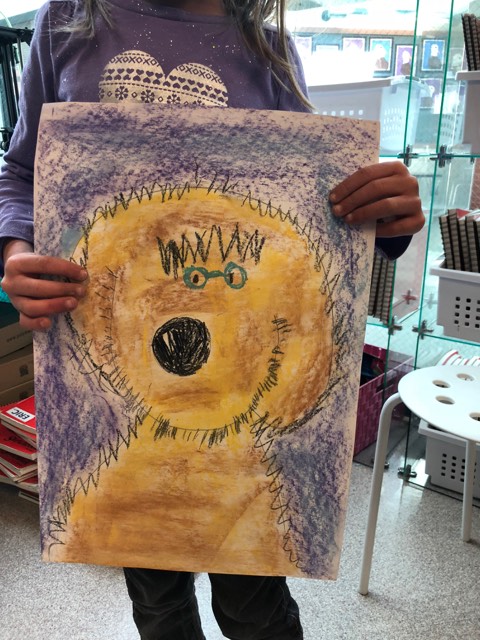
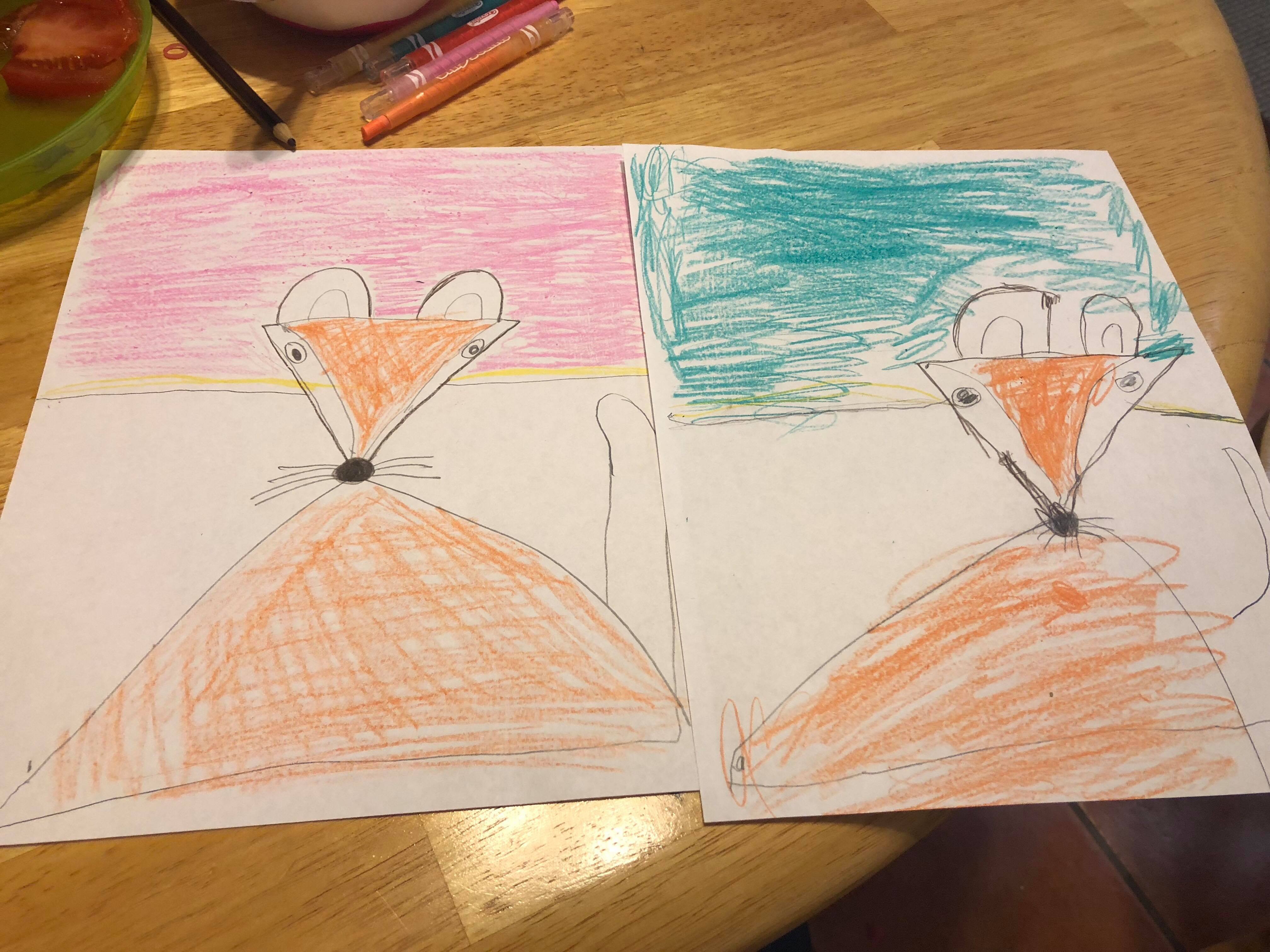
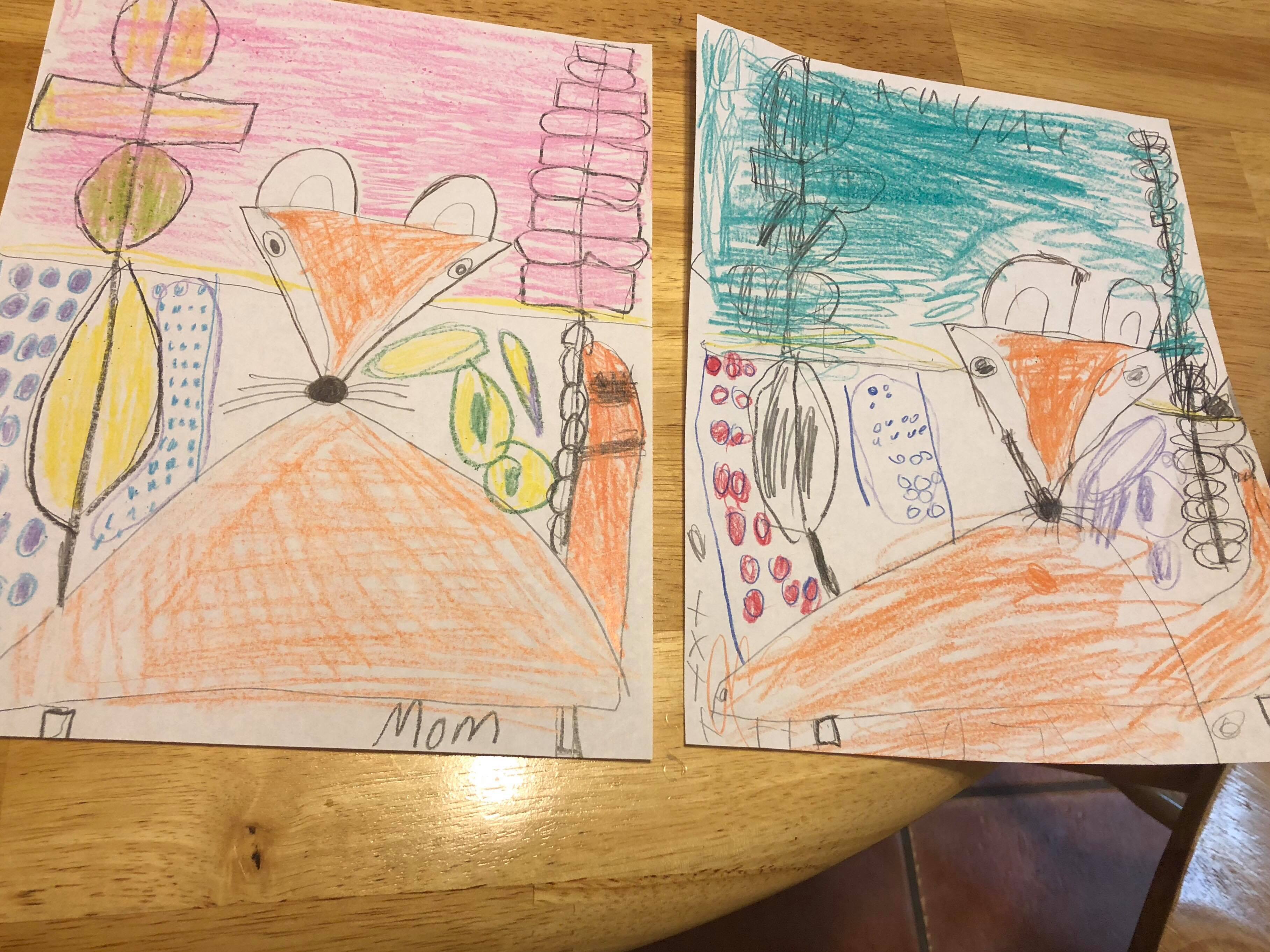
Fast forward 30 years and I have a little past second grade daughter myself. She has a laundry list of learning disabilities, many stemming from an etiology in motor planning and cerebral palsy. Everything for Ashlynn seems hard. She has had to fight and claw her way to learn anything through hours and hours of therapy. I’m not kidding. In Elementary school, she started coming home with art pieces from art class that were nothing short of amazing. They were so amazing, it was sadly hard for me to believe that she did them without help. However, her art teacher maintained she taught all the kids in a very structured way, giving them multiple opportunities for practice (think motor planning) before completing the final piece. This was Ashlynn’s best one from last year.
Despite this, Ashlynn had never demonstrated to me independently she could draw even remotely close to this on her own.
That was, until tonight.
“Mommy, do you know how to draw a fox?” Ashlynn asked me tonight at dinner.
“Oh baby, I don’t really know how to draw much of anything,” I answered while my husband snorted his drink out his nose in laughter before adding,
“That much is true! Mommy is not an artist.”
I shot him an evil glare but unfortunately there was no denying the truth.
“Can I teach you how mommy? I learned how to draw a fox in art?” Ashlynn offered.
I agreed and after dinner she had gathered paper and coloring utencils and set to work. I really wasn’t sure what to expect.
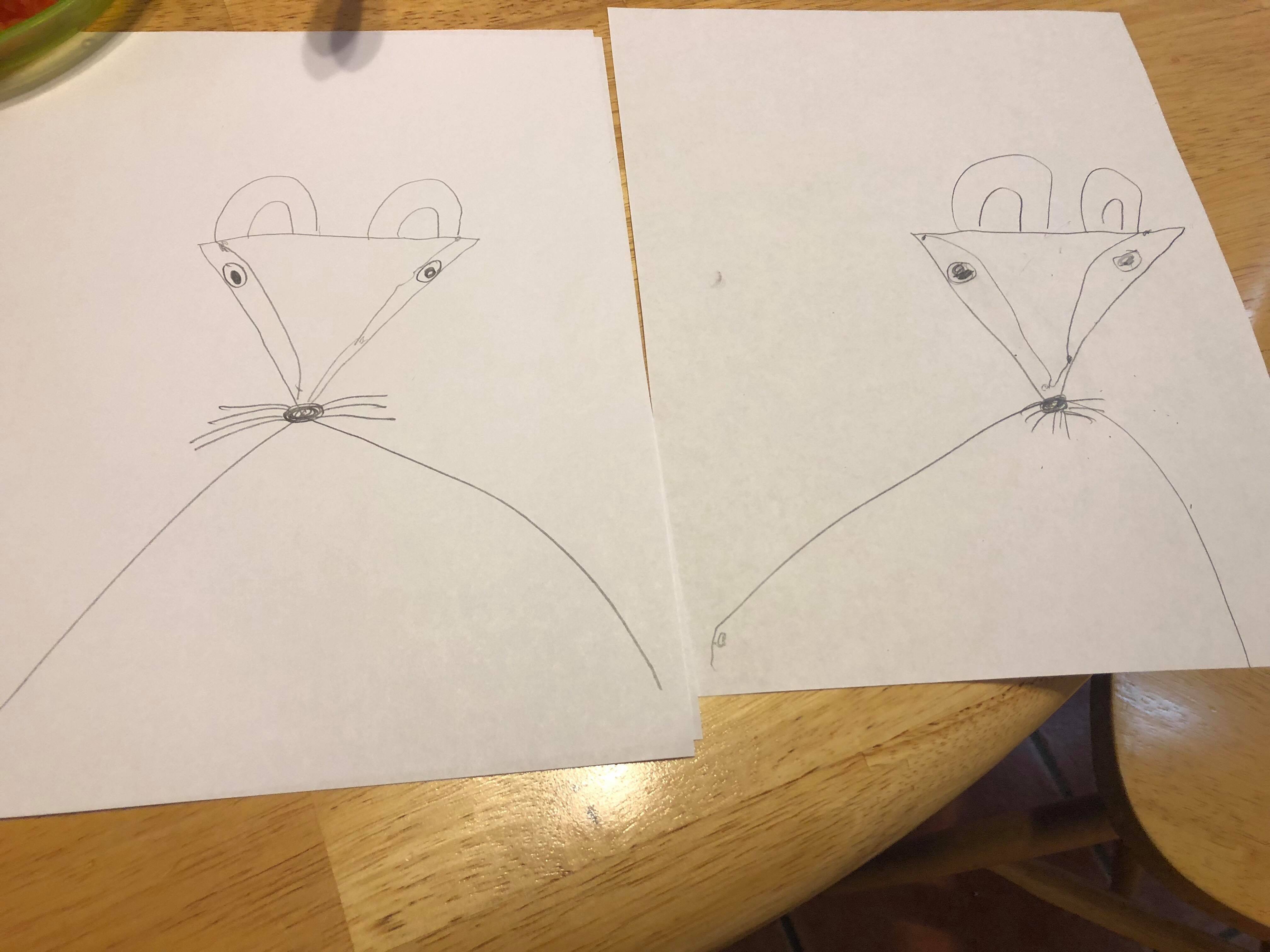
“Put your fist in the middle of the paper like this, and now draw a line across the top,” she instructed.
I complied.
“Now connect this line to this line and see? We made an upside-down pizza,” Ashlynn continued.
I looked at the perfect triangle and my mind raced back to three days earlier at OT where the therapist told me Ashlynn’s hardest shape to draw is a triangle because of the diagnal lines. I stared incredulously again at Ashlynn’s perfect triangle.
“Mom! Are you paying attention?”
She then took me in precise detail through the rest of the picture.
I was impressed by this.
“You are such a great teacher Ashlynn,” I said.
“I know mommy because I want to be a teacher you know that. A teacher and a dog walker because that’s my deal.”
I smiled. She just produced a compound complex sentence. This girl with apraxia and a language disorder just said that.
Next was the colors.
I fought back tears. This was incredible. I watched her color the page with her wrist fluidly and precisely moving back and forth and my mind flashed back to when her OT told me that until she is able to isolate her wrist from her arm, she would always have trouble coloring within the lines. I marveled at her wrist now. Isn’t that crazy? What mom would marvel at their child’s wrist and control unless they had witnessed how hard that skill was to master.
Next was texturing and drawing the trees.
She used these terms I had never heard like “we have to jump and bump.” I followed along dutifully. At the end of her lesson I praised her. It was incredible.
“But Mommy, we aren’t done!” she said as she got out two new blank pieces of paper.
She told me we had to write about them.
Write? Like actually write? This girl with motor planning, dyslexia, and dysgraphia now wanted to write about the fox? She began writing but immediately messed up her spelling. As she peered over at my page that she had dictated, she decided to just copy my sentence. I watched her form the letters as she had been taught and practiced throughout her years of OT and copy my sentence. There was a time, she couldn’t even copy her name, I thought to myself.
“Sorry, mommy, ” she said, “I can’t write really good yet.”
I responded, “That’s okay, because I can’t draw very well.”
“But I can teach you!” she said happily.
With tears in my eyes I told her,
“If you teach me how to draw, I’ll teach you how to write.”
“DEAL!” was her enthusiastic response.
So that’s the deal.
Thirty years later my art teacher was a 9 year old girl with cerebral palsy, severe motor planning deficits and a laundry list of learning disabilities whose greatest wish in the world is to be a teacher. Little does she know, she already is.
This weekend I was the guest speaker at the Nevada Walk for Apraxia and stayed with the walk coordinator Alyssa Hampson and her family.
I flew in the day before the walk, and her house looked very typical of any other walk coordinator.
It was bursting with items such as goody bags for the kids, prizes for the silent auction, food and beverages for breakfast, signage, T-shirts, and so much more.
If you are a walk coordinator, or help coordinate a walk for any charity event, then you are probably very familiar with this typical décor that hijacks your living room the day before walk day.
I am the mother to a child with apraxia.
Being a walk coordinator is not just professional, it’s personal.
I’m literally fighting to raise funds to go back directly to apraxia research , education, and programs so that each child who has apraxia in subsequent years has access to appropriate professional services. It seems expected, or at least natural as to why I would have such as invested interest. I’m fighting for my child and those like her.
That’s why watching someone like Alyssa and her family was more than inspiring.
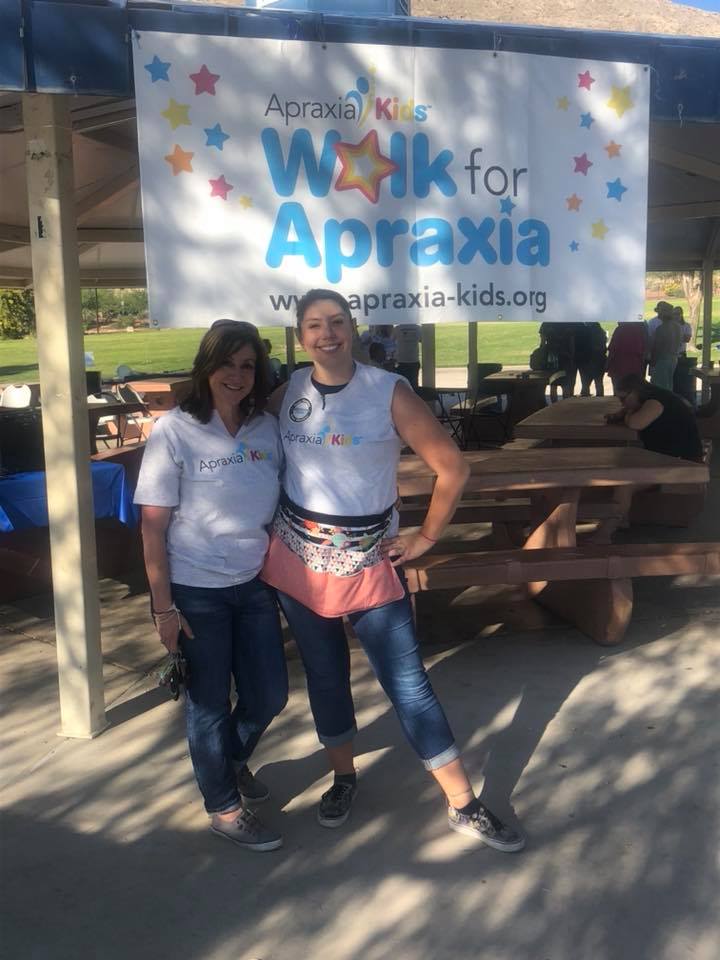
Alyssa is the walk coordinator for Nevada, but she is also a wife of almost 30 years, a mother to two beautiful, young adult children (who don’t have CAS), and an SLP with a passion for Childhood Apraxia of Speech. At her house for the past 3 years, the Walk for Apraxia has been a family affair.
Her daughter came down from college with her friends to help Alyssa run the walk. I was there because Alyssa had asked me to attend as the guest speaker.
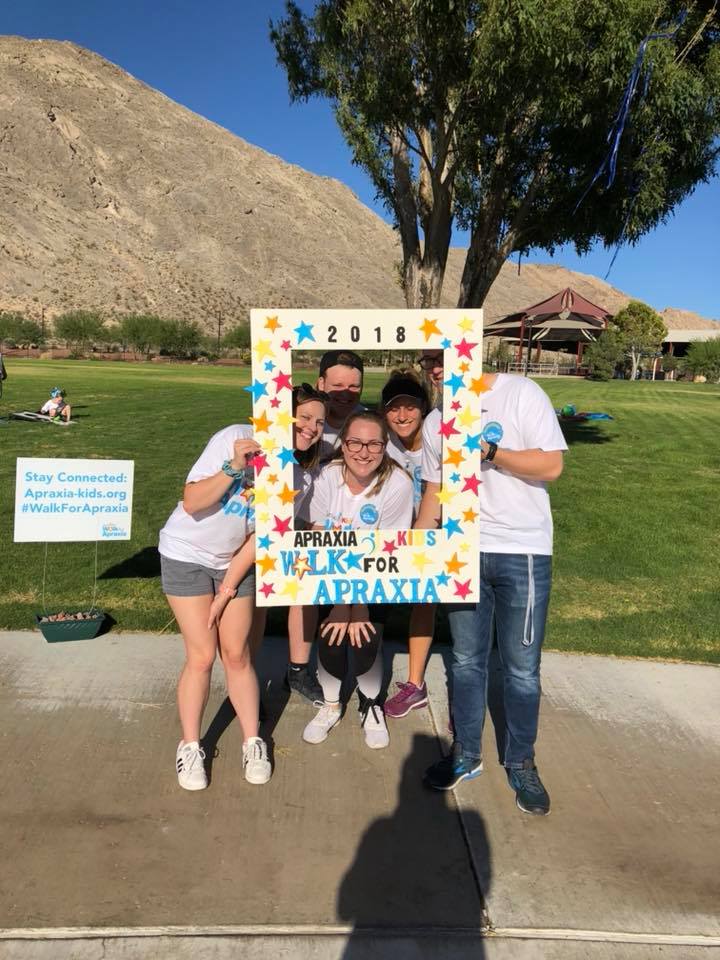
Lauren on the left with college friends to help out on walk day.
The night before the walk, her husband helped pick up the bagels and balloons as her daughter printed out forms and signage that were to be used at the walk. As I perused the silent auction items and game station activities, I discovered that Alyssa and her family had paid for much of these themselves. As a fellow walk coordinator, I was struck by their generosity and willingness to spend so much of their own money to ensure the walk was a success.
The day of the event was a full family affair, with another apraxia mom, Ashley Winter joining the crew with her husband. Everyone worked diligently setting up an event that had been in the works for months. Alyssa’s husband Dennis set up the silent auction, while his sister and their daughter’s friends helped decorate the park and set up for registration.
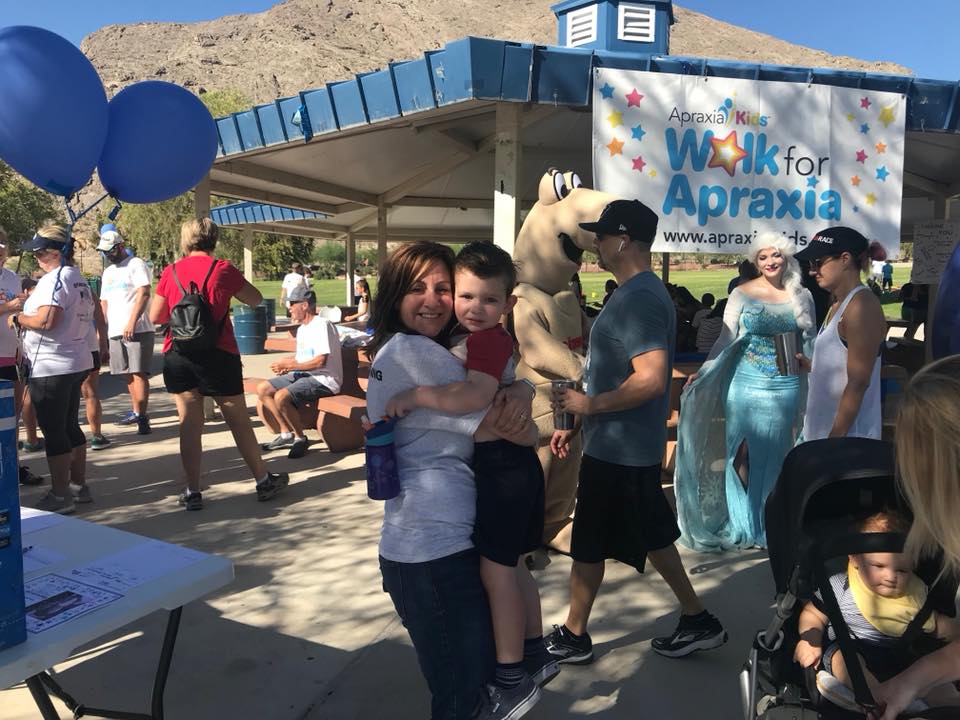
Characters that had been secured such as a clown, the princess Elsa, McGruff the crime dog, and Deputy Dripp for the Clark County Police Department all showed up on time to provide photo ops and entertainment for the kids.
I talked to many families and some SLP’s who specialized in apraxia and did my best to connect members from the community with each other.
That is what these walks are about. Community.
The walk is the chance for families to connect with their people. The walk is the place a family can go and not feel judged and just let their kids be themselves free from criticism. There was one child who had to sit on the side watching the event for around 20 minutes before he felt comfortable to join in, and no one batted an eye. There was another child who had a sensory meltdown during picture time and a parent looked at me and said,
“ I want to just give her a universal sign that says, I’ve been there and I feel you. You’re doing a great job.”
Before the walk started, the coordinator Alyssa went live in her event facebook group and talked about the day to come. Another apraxia mom in California commented that she was moved to tears that Alyssa was an SLP, not a mother, but who still was coordinating the walk. Alyssa didn’t know why until I explained.
Alyssa with one of her clients
As a mother to a child with apraxia, my motive for coordinating the walk is clear. I walk for my daughter. For Alyssa, she has developed a special bond with kids like mine, so much so that it compelled her to donate and volunteer her time for kids like MINE. For kids like YOURS! It’s touching that a therapist cares so much for kids with apraxia that she is willing to give up her personal time, energy, and money to coordinating a charity even like that for the Nevada Walk for Apraxia. It’s amazing that she in turn inspired her entire family to do the same!
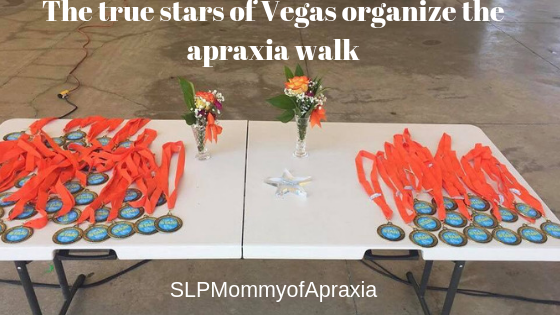
Usually my favorite part of the walk is the medal ceremony, where the kids are honored with medals for all the hard work they put in every day to learn how to do the one thing many of us take for granted: learn how to speak.
That was still a great part, but at the Nevada Walk for Apraxia this year, I had a different favorite part.
I witnessed a family brought together by the shared mission to help kids like mine.
They had no personal investment accept that the matriarch of the family was passionate about these kids and in turn, had made them passionate too.
I marveled at her sister in law who made the beautiful crafts and decorations like the photo booth picture frames. I looked on in amazement as her daughter, clipboard in hand, managed the day of event details with professionalism and meticulousness. I looked on in admiration, and also amusement as her husband manned the silent auction and was so invested he took every donation personal.
“No one is bidding Alyssa,” he exclaimed in his New York Accent. “Whatevah, it doesn’t mattah,” he continued. “If no one buys it then we will just buy it and that’s it. We’ll buy it all and forgettah about it,” he said before storming off.
As much as I was amused by his accent, I was more inspired by his passion.
What did this man care that no one was bidding? He didn’t have a child with apraxia. He only had client stories from his wife, but he had also become so personally invested and fell such in love with kids like mine that the success of the silent auction to benefit apraxia was now personal to him.
Alyssa and Dennis
Where did people like him come from? I was amazed and touched. My daughter and others like her benefitted from a New York Jew (his words not mine) living in Las Vegas who cared about kids like mine.
How can one NOT be touched by that? How can anyone who loves a child with apraxia not be touched by the dedication of this family? What is more, is how are families who DO have a personal interest in apraxia NOT this dedicated to the cause?
It’s inspiring and the walks for apraxia around the country all have a personal and unique story like theirs.
As I was leaving today, Alyssa pointed out that it was Rosh Hashanah. Other than knowing it was a Jewish Holiday, I asked her the meaning of it. She sent me information that read,
“Rosh Hashanah marks the beginning of the Jewish New Year. We review the choices we have made over the past year, our actions and our intentions, as we attempt to honestly evaluate ourselves.”
I couldn’t help but think of how symbolic it was to have Rosh Hashanah fall on this day I met a Jewish family coordinating the Walk for Apraxia.
My friendship with Alyssa and her family grew this weekend marking the beginning of what I knew was great things to come in the future. In addition, as a time of reflection and introspection, I hope that when her family evaluates themselves this holiday, they are proud for all that they do in their small part of the world raising funds and awareness for children with apraxia.
I was blessed this weekend to get to know Alyssa and her family more intimately than I ever had. In the spirit of Rosh Hashanah, I spent time on the plane reflecting on my last year and my choices, intentions, and actions. Am I living my life with authenticity? Am I true in my intentions and my actions? This is a great task for any of us to participate in, regardless of if we are Jewish or not.
Ghandi once said, “The best way to find yourself is to lose yourself in service to others.”









 A
A