Category: apraxia blog

  • Boot camp

    I am currently at an apraxia intensive institute, aka “bootcamp.”  I live in Colorado, and this bootcamp is in Pittsburgh.  I’m a Colorado native and I’ll admit, I’m not well traveled and I really don’t care.  When my husband asked me to marry him, I told him I hoped he really liked Denver because it would take a lot of get me out of here.  My family is here.  My history is here.  My roots are here.  Plus, I love the state, I love the city, I love the attractions, I love the people, I love what it has to offer.

    Many people love a 7-10 day vacation, but for me, I want to come home usually after day 4 or 5. I knew this bootcamp would be hard, because it’s four days, almost five, away from home by myself. However, I did it because I know it is for the best.  I know I’m doing it for all the right reasons.  I know it’s a once in a lifetime opportunity and I had to seize the day.  I know I was called to apraxia for a reason, and I want to be one of the best damned SLP’s for the job.

    I’ve been busy and my mind has been occupied.  I am surrounded by amazing, competent professionals in the field, and that’s not to mention I am being trained under top experts in the country.  There are SLP’s even from Canada here!  How lucky am I?

    I can’t wait to blog about the experience; however, tonight is about catharsis.  I write because I am a writer.  I write because writing is a vehicle to express my emotions and as I write, my soul slowly feels healed; if only for the night.

    We finally get a break here at bootcamp.  The experts hosted a “wine and cheese” night.  If you know me, I’m not one to turn down a party.  If there was/is a party and I can go, I’m usually at it.  However, downtime only let my mind wander.  What are my kids doing?  How was their day?  What did they discover today and what made them laugh?

    My focus is drawn back to loud laughing and witty joke telling.  A room full of SLP’s never disappoints to produce loud banter, clever plays on words, jokes only SLP’s understand; basically, the stuff I live for.  I smile and actually laugh until I cry, but then I wonder, “Is it bath night?”  Did Ashlynn wonder why I’m not there to read her book?  She always wants me to read a book, and sometimes I’m tired and I don’t want to, but I do it anyway, because I know this time is so short.  One day she can read her own book, or she’ll have homework, or she’ll want to talk on the phone with her friends instead.

    More loud laughter erupts.  Why can’t I enjoy myself?  I think of Cody.  My party buddy since 2001.  In a room full of people, he commands the attention and he makes me laugh.  He’s funny and witty too and he loves a good party.  I married him for a reason, and right now I miss my best friend.
    And Jace.  That little boy is just like his daddy.  Such a little troublemaker, but with a heart of gold.  I miss his cute little pucker when he kisses me goodnight, his proud “I did it!!” when he does something new, and his energy that exhausts me after a long day.  What trouble did he find today, I wonder.

    More loud banter.

    I go outside for some air.  I see a rollie pollie out for a stroll on the sidewalk.  A smile cracks on my face and a tear forms in my eye.  Ashlynn loves rollie pollies.

    This experience is awesome, intense, amazing, and life changing.  I wouldn’t be here if it were anything but; however, every choice you make has a price…..and the price seems very expensive tonight.
  • Minimal pair sort

    Minimal pair sort

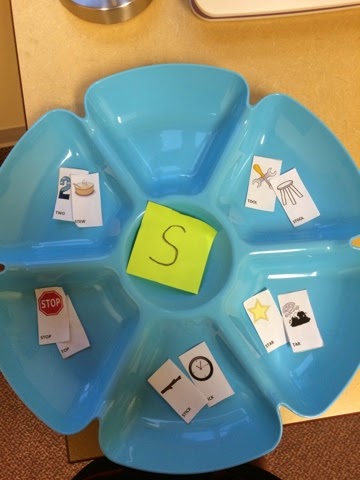
    I have a little guy in therapy right now who has a difficult time with /st/ blends.  He consistently drops the /s/ in this blend only.  To bring awareness to what he saying, SLP’s many times employ what is referred to as “minimal pair” therapy.

    Minimal pairs are two words that are similar except for one sound.  Many times, minimal pairs rhyme if the only sound changed occurs at the beginning of the word.

    In this case, I created five minimal pairs found hereST MINIMAL PAIRS

    I had him sort all initial /t/ words first.  He then traced his finger on the /s/ while making his “hissing sound” and then said the word.

    For example: “ssssssssssssss….tool.”  I then asked him what word he said, and we added the minimal pair “stool.”

    Having him physically sort the pictures and use his finger to trace the /s/ has a purpose.  Research is showing an increased connection between our hands and mouth.  (Think of when you’re trying to find a word you might circle your fingers etc).

    Having the child use their hands adds another pathway to the brain to aid in recall!

    Finally, save this tray because the possibilities are endless and I will have more ideas in the future.

  • DIY “Park your speech!”

    DIY “Park your speech!”

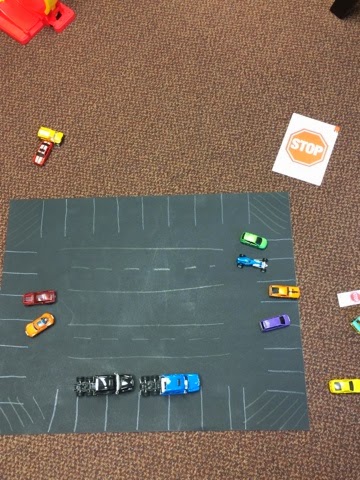
    Do you have a kiddo who LOVES cars and needs a different activity besides flash cards to work on his speech sounds? Check out this super easy parking lot activity.

    I bought a cheap black poster board from the dollar store, and mapped out a street and parking spaces using white and yellow crayons.
    This boy was working on ST blends so we said “stop” each time he parked a car; however you could glue pictures or write target word or sounds into the spaces and have them say it each time they “parked” a car!
    It’s also great if the child is only at the single sound level. Just repeat the sound and pretend it’s the sound of the engine!

  • Language with a loom

    Language with a loom

    OT and PTs can have fun and creative activities for children. They provide good tactile and/or sensory activities that can also be great for practicing speech and language at the same time. 

    This loom idea from the Inspired Treehouse is a perfect example! For instructions on this easy to make loom check it out here! http://theinspiredtreehouse.com/fine-motor-activities-simple-outdoor-weaving-loom/
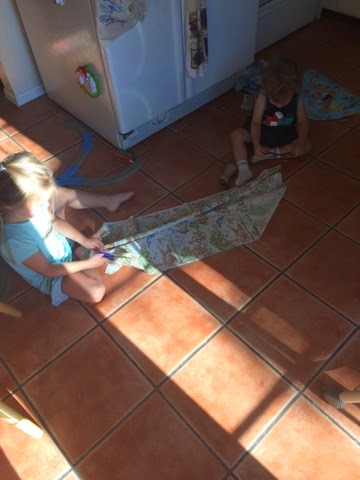
    We started first by cutting strips of material…a good fine motor activity. When my kids are cutting I have them say something for each cut. You can just make the /k/ sound, say “cut” if you’re working on initial /k/, final /t/, or on your CVC syllable shapes for apraxia therapy. For Ashlynn, we said “snip” since we are working in CCVC syllable shapes, including /s/ blends. 
    You could also practice sentences that you could set to song like “Are you sleeping” but sing “Are you cutting, are you cutting, yes I am!” 
    Melodic intonation therapy like this is easy and fun for parents to do at home!

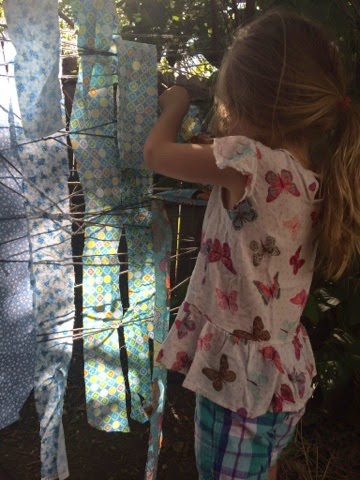
    Next, we set our sites on weaving. This activity is great for locational words such as: top, middle, bottom, under, over, up. Kids with language processing deficits frequently have difficultly with comprehension and following directions that include these concepts. 

    Ashlynn kept wanting to start in the middle of the loom and I had to keep reminding her and showing her to start at the bottom. Then while we were weaving we chanted “in then out, in then out” to get practice with these concepts; however you could also practice saying just “in” or “out” or “up” if you’re working on VC syllable shapes.
    When you’re done you can give silly directions like, “throw the ball OVER the loom” or “roll the ball “UNDER” the loom. 
    We made this over a course of two days and now the kids have a little hideaway in the backyard!

  • Speech & Language with puzzles

    Speech & Language with puzzles

    Sorting is an important foundational skill that sets up the building blocks for logical thinking and organizing.  These skills are necessary for later educational development in math (i.e. order of operations, geometry), reading (identifying main idea and relevant details), and writing (developing a topic sentence and organzing relevant details).

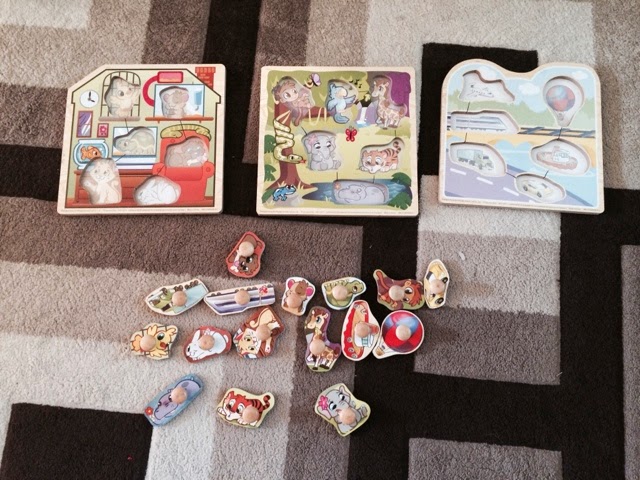
    Most parents have simple puzzles like this at home.  When my daughter was two, I held the pieces and gave her two choices.  She would have to make a sound or word approximation (because of the severe apraxia) to request and then I would give her a piece and she would find the appropriate place.

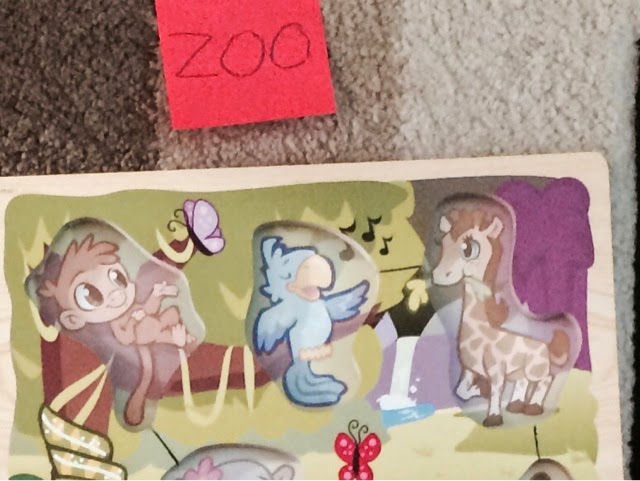
    Now that she is 4, I laid out the pieces as you see below, and she sorted them using a sentence: “A cat is a pet.”  “A tiger is a zoo animal.”

    To promote pre-literacy skills (exposure to print, print awareness), I wrote the name of the category on a sticky note and put it above the puzzle.

    That’s it!  Happy playing!
    Skills addressed:
    Sorting
    Classifying
    Expressive language
    Early-literacy skills
  • CV BINGO printable FREE!!

    CV BINGO printable FREE!!

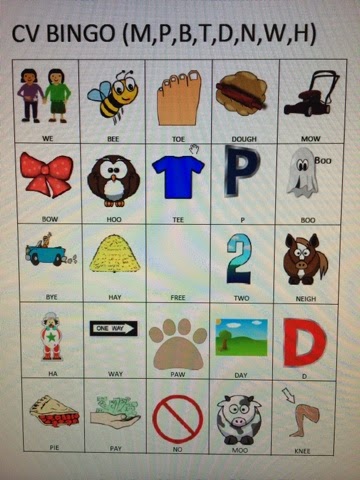
    Speech therapy for apraxia requires a motor based treatment approach that works up through a hierarchy of syllable shapes with lots of repetition, repetition, repetition.  Unfortunately, repeating the same syllable shapes is limiting and many times boring. 

    I decided to create some BINGO game sheets that can be used, starting with the CV syllable shape.  Look for more to come if you’re interested!