Category: apraxia blog

  • Back and forth book for nonverbal students

    Back and forth book for nonverbal students

    When a child starts school, a range of emotions can be present in BOTH the parent and the child. When Ashlynn started preschool at three years old, she had only ever been watched by family.  This was fortunate for us because since she was essentially nonverbal for her first three years of life, my husband and I knew we wouldn’t know if someone hurt her or abused her.

    Conversely, we also wouldn’t know anything about her day if we relied on her to tell us.  I wouldn’t know what songs she sang, what friends she made, what activity she enjoyed, what she learned, or even what she ate for snack.  Basically, it can be heartbreaking and a little terrifying.

    Currently I’m working in a program in the schools for many kids with severe communication needs. Just because they are elementary level, it doesn’t mean the parents still don’t have those range of emotions, worries, and desire to hear about their child’s day.

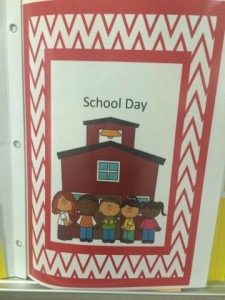
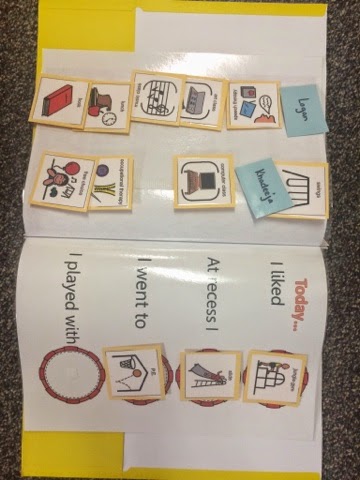
    I came up with this cute back and forth book we’ve been using with some of the kids.  We printed the sheets out and laminated them.  We then put velcro on and the kids can pick the pictures and put them in the circles for that day.

    For example, in the picture below, our little friend said today  he liked the jungle gym, played on the slide at recess, and went to PE.

    You can also get pictures or have names of the child’s classmates that can be put on with velcro or written in with dry erase marker on the bottom circle, “I played with ____.”


  • What to do when you can’t say “Trick or Treat”

    What to do when you can’t say “Trick or Treat”

    Ashlynn said her first “trick or treat” on command at the age of four.  At three…she had an approximation, but then she froze when we went trick or treating.

    Many people were polite and kind, not demanding she say something for her candy.  Others though, sat indignantly at the door waiting for “the magic words.”  Because Ashlynn’s strengths lie in social skills, she was always able to charmingly muster up the word “hi” instead, and most of them would give her the candy.

    However, many of my clients report anxiety around this time of year for them and for their child with apraxia.  I’ve heard of some creative ways around this.

    One client I had said she took her daughter with older cousins who all went in a group and spoke for her, if you will.

    Another client had a sign that said “Trick or Treat”

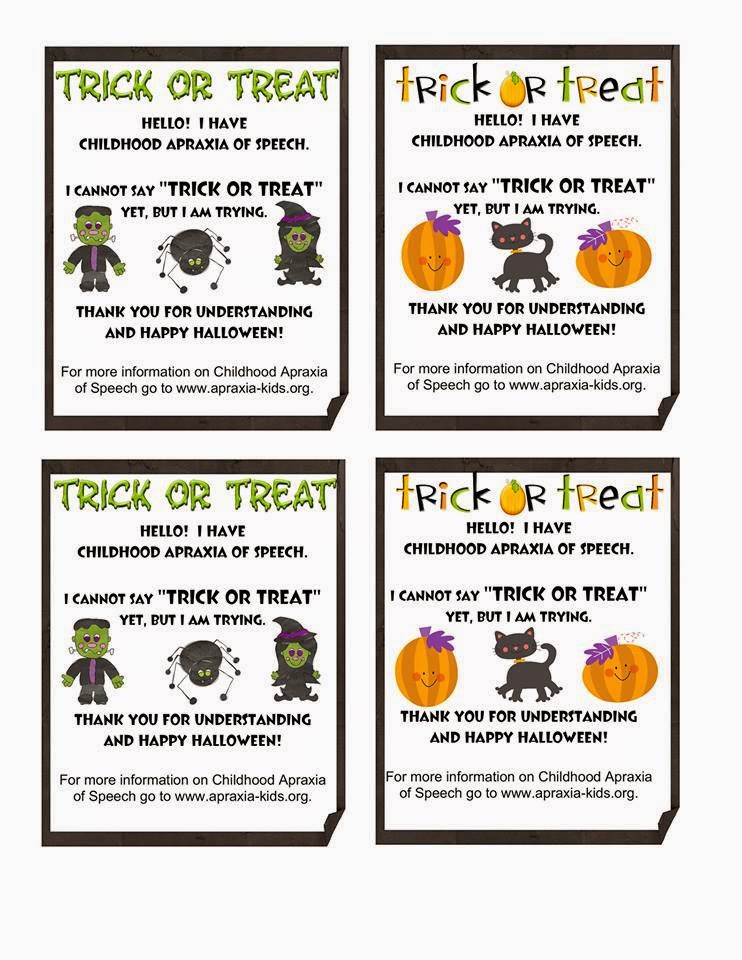
    A mom I’ve met through the fb group, made these cute and wonderful cards that not only say “trick or treat” for the child, but also spread awareness!!  I asked if I could share and she was happy to pass them along.

    So here they are!!  Thanks Shelley for your generosity!

    If you are finding these hard to print, feel free to email me at lauraslpmommy@gmail.com and I will be happy to send you along the PDF.

  • DTTC: Evidence Based Practice in Childhood Apraxia of Speech.  An interview with Dr. Ruth Stoeckel

    DTTC: Evidence Based Practice in Childhood Apraxia of Speech. An interview with Dr. Ruth Stoeckel

    Today I am honored to introduce Ruth Stoeckel, nationally recognized expert and published researcher on Childhood Apraxia of Speech.  I first saw Ruth Stoeckel speak back in 2005 when she presented in Colorado.  The packet she handed out during that talk helped me greatly in those early years when I was first learning about how therapy for apraxia is very different than therapy I had been doing for other speech sound disorders; and helped me treat the kids I did see with apraxia after that time.
    Since then, I was honored to be selected as part of CASANA’s intensive apraxia training institute in 2014, where Ruth was my mentor for four days.  I can say that during that time I was able to get to know Ruth better and I can tell you that she is absolutely passionate about CAS.
    Hi Ruth!  Thank you so much for guest blogging today.  To start, can you please talk a little about your background, where you work, and how you found yourself specializing in CAS. 
     
    Thanks for opportunity, Laura.   I’ve met a lot of great SLPs and parents through CASANA and I’m glad you are out there spreading the word to increase awareness.  
    How did I find my way to special interest in apraxia?  Lots of things seemed to push me in this direction. I did undergraduate work at University of Iowa at a time when  Penelope Meyers was there and talking with students about apraxia several years before she and Donald Robin co- wrote the book Developmental Apraxia of Speech: Theory and Clinical Practice.  When I moved to Minnesota, my clinical supervisor in the local school system was none other than Kathe Yoss, who together with Fred Darley had published an early study (1974) of a cohort of children who had a unique set of characteristics that they described as similar to adults with apraxia.  Kathe was a wonderful mentor and encouraged me to develop expertise in low incidence disorders like childhood apraxia.  A number of years later, I left the school system to work at Mayo Clinic.  I have had the opportunity  to work with and learn from two exceptional leaders in the field of motor speech disorders,  Joe Duffy and Edythe Strand.   Finally, I happened upon the Apraxia-Kids listserv  one night early in the evolution of what would become CASANA and was drawn in by the passion of the parents and SLPs who contributed there.  The combination of my work experiences and relationship with CASANA has allowed me to have great opportunities to develop my expertise and learn from both parents and colleagues!
     
    Almost weekly I get asked, “What is the BEST approach for CAS.”  I know that you are a proponent of DTTC.  Can you explain what this is, and do you feel this is the BEST approach? Why or Why not? 
     
    There is so much we still need to learn about how to treat CAS.  I have to say that, based on what we know right now, there is NO single “best” approach for treatment.  The greatest amount of empirical evidence is for Integral Stimulation/DTTC, but positive results are being seen in studies using other techniques, including PROMPT, ReST, and ultrasound in treatment. 
    I do use Dynamic Temporal and Tactile Cuing (DTTC) to guide my treatment.  DTTC is a flexible framework for dynamic decision-making in treatment – changing what you do moment to moment based on the child’s responses.  It was developed by Edythe Strand based on the adult 8-step continuum proposed for adults by Rosenbeck and colleagues.   This framework emphasizes the shaping of movement gestures for speech production using a systematic hierarchy of cues, with continued practice of those gestures in the context of speech. The focus of treatment is not on sounds – but on the movement gestures, or movement transitions for sound combinations. 
    DTTC is primarily an integral stimulation method that can incorporate whatever types of cues facilitate a child’s production, including visual, tactile and gestural.  Prosody is incorporated early on as well.  There is a temporal hierarchy (i.e. simultaneous production, immediate repetition, repetition after delay) in addition to the different types of cues.   The dynamic adjustments in temporal characteristics and level of cuing allow opportunities for the child to take increasing responsibility for assembling, retrieving and habituating motor plans.   This approach is individualized to the child by using a functional core vocabulary of words meaningful to them.  The principles of motor learning are integrated into this framework as well.  These principles are thought to be an important element for any treatment of motor speech disorder.
     
    What does the research say about DTTC?            
     
    Based on recent review studies, DTTC has the largest base of empirical research to suggest effectiveness for treatment of children with CAS.  However, the studies have been done with a small number of children, and further studies are needed to identify which elements of the framework may be key ingredients, and which may be less important.  As I said above, there is emerging evidence to  support other approaches as well.
    Since you mentioned principles of motor learning, can you provide a *brief* overview?  What do SLP’s really need to be doing differently from traditional articulation or phonological based therapy?
     
    Edwin Maas and colleagues wrote a great tutorial in 2008 that I recommend to anyone interested in motor speech disorders.  There have been a few small studies since then that have looked at these principles on a more individual basis, but there is still much to learn about how they apply to speech therapy.  
    Key aspects of treatment that are different for apraxia versus phonological disorder  are that apraxia therapy focuses on movementsequences rather than sound sequences and that it emphasizes working on movement sequences (coarticulation) within and between syllables.  Repetition is another key difference.  Based on just a couple of studies, there is evidence that we need a large number of repetitions per sessions to help a child establish the needed level of skill for producing a target.  It may take some time to build up to, but I try to get 100-200 repetitions of targets within a 20-30 minute session.  How those repetitions are organized is decided using the principles of motor learning. As they are laid out in the Maas article, we consider these principles as a way to influence how a child acquires a skill and then transfers or generalizes the skill.  They include the following:
     
    *Massed versus Distributed practice, which is many trials in a short period of time compared to practice of a given number of trials or sessions over a longer period of time.
    *Variable versus Constant practice, which is working on the same target in the same context as compared to practice on different targets in different contexts
    *Blocked versus Random practice, which is working on different targets in predictable blocks or treatment phases compared to mixing practice on various targets in less predictable ways.
    *Simple versus Complex task, which is a focus on “easier” sounds and sequences (what the child can say, or what is presumed easier or earlier developing) compared to more complex sounds and sound sequences.
    *Feedback on performance versus feedback on results, which is telling the child what behavior was produced accurately (e.g., you got your lips closed before you started”) need to do differently as compared to telling them “you got 3 out of 5 right.”
     
    Many SLP’s want to know how to pick therapy targets.  Where do you start when picking targets?
     
    I start by:  1) identifying the child’s phonetic repertoire; 2) their phonotactic (syllable) repertoire; and 3) finding out from the child and their caregivers what words are important and potentially motivating for that child.  In my motor speech exam, I probe the words that I might consider including as therapy targets by exploring what sequences the child can produce with different levels of help.  I want to try to expand their sound repertoire and their ability to sequence syllables, looking for how I can do that using a core functional vocabulary.
     
    What if the child has a later developing sound in their repertoire?  Would you include this in a potential target word?
     
    This comes up a lot.  Many SLPs are trained in their graduate programs to think of a “sequence” of sound development and to focus efforts on sounds thought to be earlier developing.  It seems that among the folks who have been doing this a while (it’s not validated in a study as of yet), the kids with apraxia “didn’t read the book” on speech sound development.  It’s possible they will have an “sh” or /r/ in several words before they have a consistent /b/or /m/.  That is why I think it is so important in assessment to survey the child’s phonetic and phonemic repertoire and to build the targets used in intervention on sounds that the child can produce either on their own or with help, regardless of where it is on a chart.  So, for example, the /s/ sound is very important in English for intelligibility and as a linguistic marker.  If a child is stimulable for it at all, I go for it in vocabulary targets, even though it’s considered later-developing.
     
    Do you ever use oral motor exercises in the treatment of CAS?  Why or why not?
     
    I want to be very clear in my response to this question.   Because speech is accomplished by moving the mouth, pretty much everything we do in speech therapy can be considered “oral motor” work.  The key distinction seems to be doing “exercises” vs “speech work.”   I do use some physical materials to assist with placement, like suckers or tongue depressors, and I do sometimes have a child practice a speech movement a number of times without speaking as a way to simplify the task at first.  But I always move the child as quickly as possible from that type of practice to using the movement in the context of a spoken target.  I don’t presume that practicing nonspeech tasks (e.g., chewing, blowing, etc. ) will result in improved speech movements and never ask a child to practice repetitions of isolated nonspeech movements or exercises to “strengthen” or “increase awareness of movement.”   Based on what we know of speech physiology, muscle movements are task-specific rather than muscle-specific.  That is, the activation pattern for a given muscle is different depending on the task that it is doing.  So we need to teach a movement in the context in which it will be used.
    What advice would you give for a beginning clinician who has minimal background on apraxia and apraxia therapy?  Do you have any webinars available for viewing, or good articles they could use as a start guide?
     
    I’d advise a clinician with minimal knowledge of background to do 2 things:  
    1) to find a colleague who has expertise and can provide mentoring; and 2) take advantage of the wealth of information available at the Apraxia-Kids website.  Next, they could attend workshops or webinars sponsored by CASANA.   I think it’s usually more meaningful when seeking information to be pursuing it for a particular student – as it was for you, when deciding you needed to learn about apraxia because of Ashlynn.  I think the  information will be more relevant and perhaps “stick” better when it is being sought for an immediate purpose.  Then that learning can be transferred to how one thinks about additional students who come along later with apraxia or severe speech sound disorder.
    Thank you SO much Ruth for being here today!  I am honored and thrilled that you agreed to guest blog.  I continue to admire your work in the field, your dedication to the children and their families affected by CAS, as well as your contribution to the field with your research.
     
    Thanks so much for having me!

    To learn more on DTTC read this tutorial by Dr. Edythe Strand

    A free course is also available online for CEU’s at ChildhoodApraxiaTreatment.org 
     
    Ruth Stoeckel, Ph.D., CCC-SLP is a speech-language pathologist at the Mayo Clinic in Rochester, Minnesota.  She has experience working as a clinician and independent consultant in schools, private practice, private rehabilitation agency and clinical settings.   She specializes in assessment and treatment of children with severe speech sound disorders and developmental challenges.  Dr. Stoeckel has participated in research studies on apraxia treatment and on the relationship of speech sound disorders to later learning disorders. She has presented workshops and advanced trainings nationally and is known for presenting practical, evidence-based information that participants can put to immediate use in their day-to-day practice. Dr. Stoeckel is on the Professional Advisory Board of CASANA and has been a faculty member of the Intensive Training Institute sponsored by CASANA.
     

  • Annual IEP – year 3

    Annual IEP – year 3

    It’s been two years since Ashlynn was first identified as having CAS.  She is now almost 5.  At her first IEP meeting, I remember praying that she would talk.  If she would just talk, everything would be okay.

    Last year, she was talking, but they explained she had a hard time fitting in with her peer group.  She would tend to just repeat what others said, but she was at least “staying in the game” with this strategy.  At that meeting, I remember they also said they were concerned with her attention.  At one of the parent teacher conferences last year, they told me she couldn’t identify the letters of her name.  I worked on it every night.  I bought letter puzzles, alphabet cards, and we practiced identifying the letters of her name and sequencing them.

    This year, she can identify ALL the letters of her name.  She notices them on billboards and store signs.  She has this down….it’s just she has 20 more letters to learn before she goes to Kindergarten next year.  Sweet Jesus, why do babies need to know so much so early now!!

    They remain concerned with her attention.  It doesn’t really look like ADHD, but maybe it’s something we need to look at later.  Oh, and then there is the cognitive test.  They want one of those in the Spring too.  I don’t want a cognitive test.  My immediate reaction is “no.”  However, Deb, her private SLP and my friend pointed out that I should find out the reason they want the test.  If they want it to determine a label….no.  If they want it to find out other information to help her programming, maybe.

    I’m just worried because with her difficulties with fine motor skills, speech and language, and visual motor…..I know the score is going to come out low, and quite frankly, I can’t look at that right now.  Maybe I’m in denial, but I just don’t see how they can get an accurate score when she has so many difficulties that could influence it right now.

    Another issue I was flabbergasted to learn, was that Ashlylnn can’t categorize.  This is where children identify items based on similarities.  They sort items.  I clarified if they tested her receptively so she didn’t have to name them.  They did.  The school SLP said she had three categories: clothing, toys, and food and she didn’t categorize them correctly.  They did say attention could have been a factor, but then I took her to private SLP and she confirmed it.  Seriously??  I just did an activity this summer that she rocked it.  Sigh.  I don’t know why she’s not transferring it, but I can’t believe I have another basic skill that we need to work on.

    Her goal to sequence pictures was not met.  I knew this though.  She simply doesn’t look at the pictures and their details to realize what comes first, second, or third.  I need to work on that.

    And this folks is why even after attending probably hundreds of IEP meetings in my career, I absolutely LOATHE them when it’s my own kid.  Despite all of the positives ( oh did I mention she’s asking questions and socializing with peers), I have to hear all of the problems.  All of the things I need to work on and my shoulders feel so heavy.  Despite this though, I have to pull on my big girl panties and attack it.  I have to put aside my fears and just step one foot in front of the other.

    I’m choosing to think about ALL the gains she’s made in PT and OT recently.  The PT said she could navigate ALL the playground equipment now like any other kid, and even shows beginning swinging skills of pumping her legs that other kids her age don’t have yet.  My husband beamed.  This is his area.  This is his hard work paying off.

    Her legs and core are getting stronger.  In private OT she just pedaled her Big Wheel for 14 consecutive rotations!!  She fatigues, but she’s getting stronger.

    Her power wheel that was too much to motor plan pushing the throttle AND steering…..well she’s doing both now on our sidewalk.

    In private swim lessons she’s now holding her breath for 5 seconds while she kicks her legs for two laps straight before she tires.  When I watch it, I cry because this girl almost drowned and she got right back up and attacks it.  Every time.  She attacks it.

    If she attacks it, what excuse do I have?  My husband says every goal we’ve made she meets.  She does, it’s just so much work and it stresses me out.  I’m terrified she’ll have dyslexia on top of all of her learning difficulties.  I hate to see her struggle.  She’s struggled all of her short life.  When will she get a break?

  • September Specialty Series: Using AAC (Alternative and AugmentativeCommunication). A mother’s story.

    September Specialty Series: Using AAC (Alternative and AugmentativeCommunication). A mother’s story.

    To continue my September Specialty series, I want to introduce Merry. Merry is an amazing mom, and I wanted to feature a mother because in my opinion, parents are the experts on their child.  I think it’s important professionals keep this in mind, so I’ll say it again.

    Parents are the experts on their child.
    Her daughter is using an AAC (Assistive & Augmentative Communication) device at the age of 2 ½!!  I thought she was the PERFECT guest to talk about AAC because many parents aren’t even told it’s an option, or they are told their child is too young.  I’m a big believer that mothers know their child better than any professional and are their biggest advocate.  Merry is proof of this!  Thanks Merry for guest blogging!

    Tell us a little bit about yourself and your child with apraxia.
    I am a young stay-at-home mom with no background or experience with speech or medicine. I’m actually a funeral director by trade and education. However, I consider myself very science-minded and I try to do things in an evidence-based manner whenever possible. I think that’s been very helpful to me in my journey as a special needs parent.
    My daughter, Elanor, is my only child. She is 2 ½ and absolutely loves music, dancing, animals, and most children’s television programming. She is especially fond of Blue’s Clues. She has a lot of trouble learning to speak due to childhood apraxia of speech. She also has dyspraxia, which is basically a full-body apraxia. This makes a lot of other things hard for her, including things like running, jumping, or putting on shoes. She has had her communication device for about a year now. It is an iPad mini with a communication app called Speak for Yourself and an amplified case called an iAdapter. We call it her talker.

    When and how did you discover your daughter would benefit from a device?

    I remember being at a friend’s daughter’s birthday party when Elanor was about a year old. There were several parents all bunched into a corner talking about their children’s speech problems. Most of their kids were older, and some were already in speech therapy. My husband and I looked at each other kind of pridefully, because that was one problem we knew for sure that Elanor didn’t have. At one year Elanor may not have been walking (or anywhere near walking) but she had a good number of words, probably about 10.
    At 15 months when Elanor stillwasn’t walking, we followed a random tip and pursued ear tubes for her. We had heard that fluid in the ears could mess with a child’s balance, and that seemed to be Elanor’s problem. We had about a month of many many doctor’s appointments to look at her ears and talk about tubes. It was during this time that my husband and I kind of looked around and realized she hadn’t said anything in a while. Sometime between 12 and 15 months she lost all of her words and most of her sounds and we had barely noticed. It was assumed at this point that the ear tubes would fix everything. She had ear tube surgery at 16 months and walked two days later, but she remained nearly silent.
    At that point we were already in the process of getting early intervention from the county due to the walking issue. At the first assessment they were no longer concerned about her walking but shared our concern over her speech. We were told to come back in a month if she still had no words. It was during this nearly silent month that I happened to read something in a mommy forum about apraxia of speech. A lot of it really seemed to fit. Elanor couldn’t stick out her tongue, she couldn’t pucker to kiss. She had a lot of trouble eating. Her speech had progressed backwards instead of forwards. The symptoms really seemed to match. Of course, I couldn’t be sure about any of the main symptoms of apraxia (like inconsistent errors in speech) because in order to see those symptoms she would have to be able to speak, which she really couldn’t.
    During one of my many googling sessions I came across a video on YouTube of a child with apraxia using a communication device. He was using Proloquo2go (a communication app on the iPad) to ask his mother for a snack. I remember how incredibly happy he was to be able to tell his mom exactly what he wanted. I knew then that I wanted that for Elanor. I made an appointment for a speech evaluation with a private clinic. We discussed a communication device at the very first appointment and things went from there. Elanor was 18 months old when she started using her device. Here is a video of the first time she ever used it:

    What advice would you give to other parents who have been told their child is not a candidate for AAC.

    Here is what I have to say to them: your child deserves an opportunity to communicate their thoughts and needs without having to wait to learn to speak and they CAN do it. This recent blog post from a Speak for Yourself creator basically blows away the entire concept of needing certain skills to be able to use a device: http://www.speakforyourself.org/2014/07/22/myth-augmentative-alternative-communication-aac-pre-requisite-skills/
    I know that Elanor continues to be one of the youngest AAC users that many speech pathologists have ever seen. This isn’t because toddlers can’t do it, it’s because they haven’t been given an opportunity to do it because people think they aren’t ready. They are. Your child is too.

    A big myth regarding AAC is that the child will “give up” trying to talk if they are given a device.  However, research refutes this.  As a mother though, how do you respond to this?

    Using a communication device is hard. It’s slow. It is so much easier for me to say things out loud than to say them on the Elanor’s device. For Elanor that’s not true because speaking is so difficult for her, but the moment she can speak a word intelligibly she will always choose to speak it because it is faster and easier. Not only that, but not everyone has a device. Everyone around her is speaking aloud all the time. She would obviously prefer to be doing that.
    I also think this worry about your kid “giving up” on speech is really misguided because the device helps with speech so much. There are a lot of theories I’ve heard about why this is the case. What I know for sure is that it works. The more we push Elanor to use the device the more her speech blossoms.
    Here she is a couple of weeks ago telling her Daddy “I don’t know”, her first real sentence.

    Who programs the device and who teaches your child how to use it?

    Me and me. I know this is different for some people who get their device through their child’s school, but since we bought it ourselves we are in charge of it. Programming Speak for Yourself is actually really easy. That’s one of the reasons I chose it over some other communication apps. There’s also a Speak for Yourself User’s Group on Facebook that is incredibly helpful with any questions about programming or anything else.
    I am able to quickly add words and pictures to Elanor’s device to make it more personal. She has all her family members and friends names and pictures in there, every cartoon character, every cartoon. Her device is really very specialized for her.
    Here she is asking to watch Blue’s Clues:
    Video: https://www.youtube.com/watch?v=rZAPrJu89VU
    As far as teaching her how to use it, I mostly do that through modeling. This means that I speak through the device just like she does. If you think about it, children learn to speak by hearing us do it. It doesn’t make sense for them to learn to use a communication device without seeing someone do that too. I get guidance on how to do this from Elanor’s speech therapists and also from the creators of Speak for Yourself, who are incredibly involved and helpful. Sometimes it seems tedious, especially if it doesn’t seem like Elanor is paying attention. I learned pretty quickly that she is always paying attention, even if it doesn’t seem like it. It is incredibly rewarding to see her use a word or sentence I showed her days before when she seemed entirely uninterested.

    Many parents of children with apraxia report increased frustration and tantrums due in part to their inability to speak or communicate in some way.  Did you have a similar experience and find that the device reduced your child’s frustration?

    I didn’t have that problem before we got the device because she was so young when we got it. She has had some means of communication, whether it be ASL or her device, for a long time. However, now that she has become more verbal I have noticed some frustration when I don’t understand what she is trying to tell me verbally. I usually have to redirect her to the device, where she can usually tell me what she was trying to say. That’s why it’s so important for me to keep modeling and using the device with her even though she is able to talk more now. It is an amazing source of relief for both of us!
    This video shows her right after I spent about 5 minutes trying to figure out what she was asking for:

    How did you pay for the device?  Are there funding sources?

    The first device we had was an iPad 2. My parents bought the iPad (around $500) and my husband’s parents bought the Speak for Yourself communication app ($200). We later replaced the iPad 2 with an iPad Mini, which we paid for ($300), and we used GoFundMe to crowdsource funds for the amplified iAdapter Case ($400).
    Compared to dedicated devices like a Dynavox, it’s pretty inexpensive to purchase an iPad mini and communication app. We’re talking the difference between $500 and $5000-$10,000. That being said, $500 is still a lot to come up with out of nowhere. For funding sources I suggest family members, churches, and local charities. I know most churches would love to fund something like this for a child in their congregation.  CASANA also gives away iPads once a year to kids with apraxia, so that’s something to look into as well.

    Do you have any additional comments/recommendations/or final thoughts that you want to tell parents who are experiencing the pain of having a child who struggles to speak?

    I just want to say that having this device has helped my daughter immensely in ways I never knew it could. I am a part of many groups of parents with children using AAC, and all of these children are doing better than they would be without a device. Their speech isn’t hindered, it’s helped, and their parents have been given a chance to really know them.
    Almost every day on online apraxia groups I see parents complaining that their child can’t tell them things. They don’t know their child’s favorite things. They don’t know what their child did at school that day, etc. I sympathize with these parents, but I can’t empathize with them because I honestly don’t know what that’s like. Elanor can tell me all those things and more with her communication device.
    I guess in the end what I want to tell all the apraxia parents out there is that you can know your child, and they can have a voice now.There’s no need to wait until they can speak. This technology is available and it is amazing. It can change both of your lives forever.
    Incredible Merry!  Elanor is so lucky to have a mama like you! 

    To read more about Merry and Elanor visit her blog: http://aacabc.blogspot.com/
  • Turning Pain into a Purpose

    Turning Pain into a Purpose

    Two years ago,
     I found out my almost three year old first born had Childhood Apraxia of Speech (CAS).  Despite being an SLP and treating CAS at the elementary level, I failed to recognize it in my baby.
    It was a VERY difficult time filled with overwhelming sadness for my daughter and guilt as her mother…an SLP who didn’t realize she had CAS.

    It rocked my world.  
    Not only did the dx devastate me, but her silence and struggle to speak was truly heartbreaking.  You CANNOT  appreciate how complex speech is until you watch a child struggle to speak.
    I was sad and I was angry.  I had a master’s degree in Speech/Language Pathology, but my education about CAS consisted of 20 short pages. Every time I think about this, write this, or say this, I can’t help but shake my head.  This isn’t right.

    I decided soon after I would become an expert in CAS and I would help not only my daughter, but other children who were the same.  I had NO idea how I was going to do this.  I researched like crazy.  I found out a national Apraxia conference was coming to Denver the next year.  I took it as a sign.  I signed up for webinars.  I created a binder full of CAS treatment and research.  I watched a three hour Kaufman video at my private practice.   I talked to my cousin who is also an SLP, and she said she had two videos from David Hammer and Ruth Stoeckel I could borrow.  I devoured them.   I expressed my desire to specialize in CAS to my clinical director.  She didn’t blink.  I had her full support 100%.

    After attending the Apraxia National Convention, I found out about an apraxia bootcamp.  I wanted in.  I talked to the founder of CASANA, and she explained it was highly competitive.  The wind kinda went out of my sails.  She still encouraged me to apply, but I didn’t feel confident.  The clinical director at my private practice started filtering the kids with apraxia to me.  Her faith in me was affirming, and I was more determined than ever.

    Then, I found out I got in.  I was a mix of emotions.  This is what I wanted, but it also meant leaving my family for FOUR days. Being without my babies, my heart, would be hard…..but I absolutely believed in this cause.  I was going to go, but…. I had never flown alone.  I had never been to the East Coast.  I had never left my babies for this long.  I read a quote, “if it’s both terrifying and amazing, then you should definitely pursue it.”  Check and check.  Its “go time” as my daughter would say.

    Then today, a little over two years after my affirmation, I received this.

    CONGRATULATIONS go to Laura Smith for successfully completing her case study and now being:

    CASANA Recognized for Advanced Training and Expertise in Childhood Apraxia of Speech. 

    I AM an apraxia expert, recognized by CASANA for advanced expertise. I am elated.  The road here was difficult, but amazing.  I once read that the definition of happiness is “the feeling we feel when striving toward our potential.”

     When striving toward our potential.  NOT when we achieve it.  So here I am.  What is my next goal?  What is my NEXT potential?  What am I striving toward?  I have some ideas.  Some small and some REALLY big.

    One thing I’ve learned from Ashlynn though…a positive attitude, perseverance, and a willingness to fail and try again = success.