Category: apraxia blog

  • and then…there were words!!

    and then…there were words!!

    Almost 1 year ago today, I met a three year old who walked into my office with his mother.  He had been receiving speech therapy since he was in early intervention. He had also been receiving private speech therapy from another office. Despite having no other co-morbid issues, he only had four words: Mama, O, Daddy, More.

    This child was probably one of the best and most adept mimes I have ever met! He had a ton of nonverbal sounds, a lot of jargon, and the most complex gesture system I have ever seen.  He was obviously very smart with no receptive language concerns whatsoever.  I diagnosed him with Childhood Apraxia of Speech that day and we started on a new path for this special little boy.

    Mom or Dad attended each session, and mom kept a target word list in her phone.  Grandma, a caretaker for this boy, came to one session to also learn and observe.

    Almost 7 months of intense therapy, this boy reached a point of therapy where I usually start to see carryover into spontaneous speech.  I waited for a month, but he still refused to try without a model or cues from me first. He largely remained nonverbal.

    I started to get worried. He has NO other problems aside from verbal apraxia.  Why wasn’t he transferring what he could do??  Maybe I should refer him on.  I’m not sure I’m helping him.

    I waited another month.  This was in December and I remember because I told mom I was sure we would start to see carryover soon, and I remember her saying it would be “the best Christmas gift ever.”

    Christmas came and went.  He still wouldn’t talk outside my room.  My heart was sad. I wasn’t helping him.

    I waited another month.  He could imitate everything I said. Actually, he could independently say most of his target words.  Yet he wasn’t. I was so sad I didn’t make good on her Christmas wish. Why wasn’t he doing it anywhere else??  Another month came and went.

    I decided to give him some real “counseling” sessions.  I was talking to a 3, almost 4 year old, and it’s hard to gauge what they understand, especially if they are nonverbal; but I decided to try.

    “Alex.  You have to take a risk.  Do you know what that means?  It means you have to try even though it’s scary.  Even though you think you’re going to get it wrong, you have to try….and Alex, if you JUST try, I promise, I promise,  I will be here to help you if you say it wrong. Okay buddy?  Listen, I can’t  be with you all day and help you talk.  I can only do it here.  The rest is up to you.  You have to be brave.  You have to go out there and try to talk and you might mess up, but that’s okay, okay?  Sometimes we mess up.  It’s okay to mess up, but I need you to try!”

    I said something like this, or the equivalent to this for three sessions straight.  It seemed to be going nowhere…..

    Until…..

    One day…. it did!

    His mom came in with new words he had said on his own that she had saved on her phone.

    “He was at his brother’s soccer game and said, Go Matthew!”

    I smiled so big.  Oh man.  In my profession, it doesn’t get ANY better than that.  He FINALLY took a risk.  He finally transferred all the blood, sweat, and tears he had been practicing with me.

    I shook him. I praised him.  I probably even danced a rain dance.

    “Alex!!!  You TOOK a risk!! You tried to talk without me and LOOK!  You did it!  I KNEW you could do it.  You’re so brave.  I’m so proud of you.”

    The words have kept pouring in after that.  Every session now is something new.  New words and phrases on mom’s phone.  Reports of

    “He’s imitating more”

    “He’s trying to say everything we say”

    “He argued with his brother for the first time ever”

    I live for that moment.  I live for those reports.  One week there were no words, and then one week, all the therapy paid off!

    That doesn’t mean he’s exited from speech.  He isn’t.  There are more sound and sound sequences left to go, but it’s different now.  He and I both know he will achieve them now, and he goes out and tries to say them all without me.  He won’t earn an award for this achievement. Everyone will just see a boy who is talking.  What’s the big deal?

    I’m lucky because I’m also the walk coordinator and I will be able to call his name and put that medal around his neck and award him for all of his hard work.  I will be able to personally tell him I SEE him,  I RESPECT him, and I’m PROUD of him for doing the one thing everyone takes for granted:

    SPEAKING

    Every Child Deserves a Voice


  • It’s rare, so no one cares?  Prevalence of CAS

    It’s rare, so no one cares? Prevalence of CAS

    What’s that?

    If you have a child with CAS (Childhood Apraxia of Speech), you have heard this question once, twice, many, numerous, too many times to count in the course of their life.  We all have developed our standard answer since we are prepared for the fact that no one knows what apraxia is.  This sadly does not just include the general public.  We run into this with doctors, teachers, professionals, and yes, some parents have even reported getting this question from Speech/Language Pathologists!

    I am a self-declared Apraxia Advocate and the reason I’m so passionate about awareness is because with awareness comes proper diagnosis, and only after a proper diagnosis can the child get proper treatment.  Only with proper diagnosis will we understand additional learning difficulties that may arise from this disorder; which means we will be better equipped to understand how they learn differently and tailor their educational programming better to fit their needs.

    We say that CAS is a rare and severe speech disorder.  We convince ourselves people don’t know about apraxia because it’s so rare, and sometimes, I think we all start to accept nothing will change.  Afterall, it only affects 1-2 children in every 1000.

    I certainly have my down moments where I have thought this, but it actually has never deterred me or stopped me from my efforts.  I’m preparing for a presentation in July for the CASANA conference, and something made me look up prevalence rates of other disorders.

    Have you ever heard of Down Syndrome?  Are you reading this thinking what a silly question? I’m willing to bet 99% of you have heard of it.  It’s covered well in graduate school for speech, and usually every school setting has at least one child with DS in the building.  At the very least, most teachers, educators, professionals, and most of all therapists have heard of Down Syndrome.

    Would it surprise you then if I told you the prevalence rates for Down Syndrome are 1-2 children in every 1000 births.  Sound familiar?  Maybe that’s just because I just wrote that figure for CAS.

    I actually started to get worked up.  Wait a minute.  What is wrong with this picture?  That can’t actually be right can it?  I thought to my own personal experiences.  At one school building I have two kids with DS and in a second, I have one.  At one school building I have two kids with apraxia, and at another I have two as well.

    Wait, so how is it EVERYONE it seems has heard of Down Syndrome, but no one ever seems to know what apraxia is?  Oh friends, this bit of data has now only strengthened my resolve.  At one point, somewhere, I’m sure Down Syndrome was a rare disorder too that no one had heard of.  Oh friends, we need to step up our game.  We need to stop accepting that no one will ever know or care about apraxia (oh fess up!  I know we’ve all been there at some point). The it’s rare so no one cares attitude is not acceptable anymore.

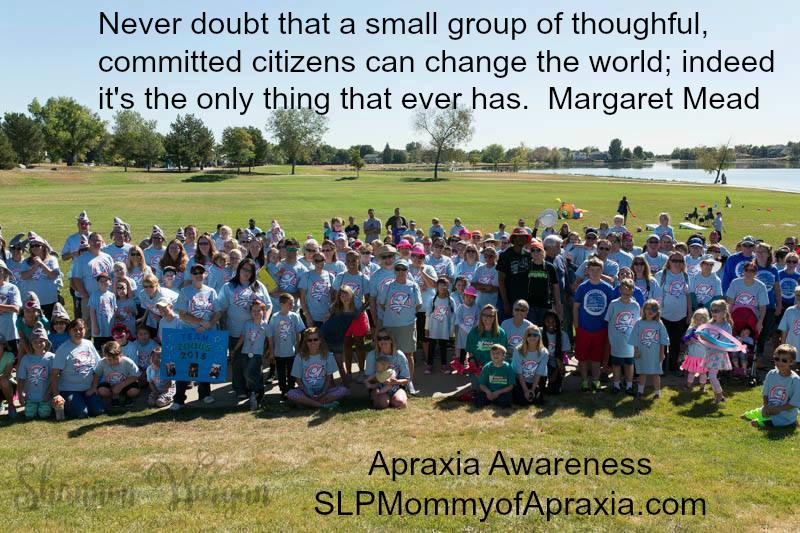
    We have to continue on!  I saw this the other day and absolutely loved it.  I can tell you I know many apraxia walk coordinators nationwide now and we all have this in common.  Every person counts.  Even one more person who knows what apraxia is, is a victory.

    Let’s stop thinking rare=unknown, because it’s not true.  We only need to look at the Down Syndrome Community to prove that point.

    It’s time to make our collective voices louder.  Join your local walk, educate the community around your child; remember, every person counts.  CAS was only accepted as a real and distinct disorder in 2007, which really wasn’t that long ago….but the point to remember is that it IS a real and distinct disorder and our children DESERVE to have professionals in their life who are as familiar with apraxia as they are with Down Syndrome, don’t you think?

  • She speaks for herself this 5th Apraxia Awareness Day.

    She speaks for herself this 5th Apraxia Awareness Day.

    I remember being in 1st or 2nd grade, the age Ashlynn is now.  I was always struggling to fit in.

    There was a girl in our class who had special needs.  I remember she wore this heavy, pink, furry coat and she talked with slurred speech.  She would sit outside, even on the hottest of days in that coat.  Usually, she was by herself.  I don’t remember how it came out, but my mom told me one day I should spend one recess a week with her as she must feel so lonely because she didn’t have anyone to play with.  I looked at her like she MUST be kidding.

    “Mom!!  I can’t sit with her!!!” I remember saying imploringly.  I knew she might be sad, but that would kill my chances in the “fit in” department.

    “Well, Laura” my mom would say, “I hope one day when you are lonely, the same kindness you showed will be given to you.”

    Ugghhhhhh

    There it was, the Catholic guilt, and can I just say it’s a thing and it works?

    So, there I went….every Thursday I think, and I sat under this tree she liked to sit under and we played jacks.  I remember her laughing and smiling, more than I had ever seen her; and instead of feeling good I was being kind to someone and making their whole day if not whole week, I was so consumed with worrying how I would be perceived and if the kids would thrust me to the position of outcast because I was playing with one.

    How awful is that?  I would like to remind everyone I was 7 or 8.  It’s not a memory I am  proud of, trust me.

    I think of that girl a lot since I’ve had Ashlynn.  Ashlynn ( I don’t think) has ever been an outcast.  That girl makes friends everywhere.  She has not come home crying because her feelings have been hurt.  Even when she had few words, she was one of the most social people in the classroom.

    Ashlynn though cannot stand for others to be alone.  She just simply will not have it.  She thinks nothing of needing to fit in, or worrying about how she will be perceived.  If someone is alone, it simply must not be.

    I relayed a couple months ago about the boy with autism who started her school two months ago.  I just happened to be in the lunchroom when he was sitting by himself and the girl with apraxia of speech yelled (literally) across the lunchroom and told him to come sit by her.  I just met his parents this weekend at the school carnival and they said this boy comes home daily and tells them Ashlynn is his best friend.

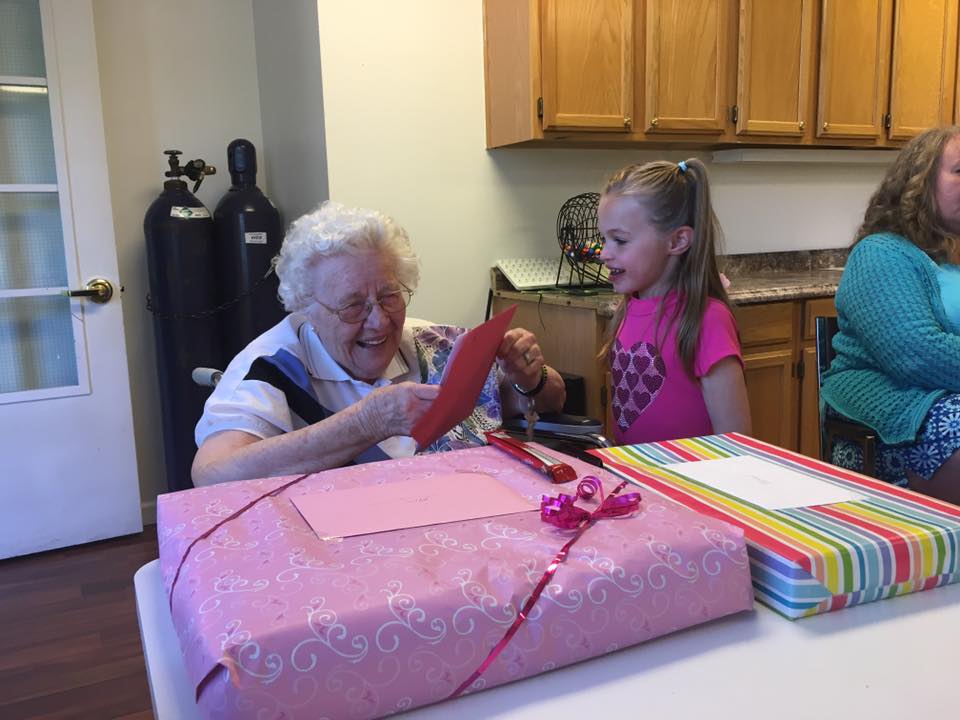
    Ashlynn with my Grandma Louis (her Great Grandma Louis)

    This weekend we went for Mother’s Day to visit my grandma, (Ashlynn’s Great-Grandma) in the nursing home.  A resident named Mary sat outside the activity room smiling, and literally looking longingly from the outside in.  Before I knew it, Ashlynn was out in the hallway talking to her.  My sister calls it “spreading her sunshine wherever she goes.”

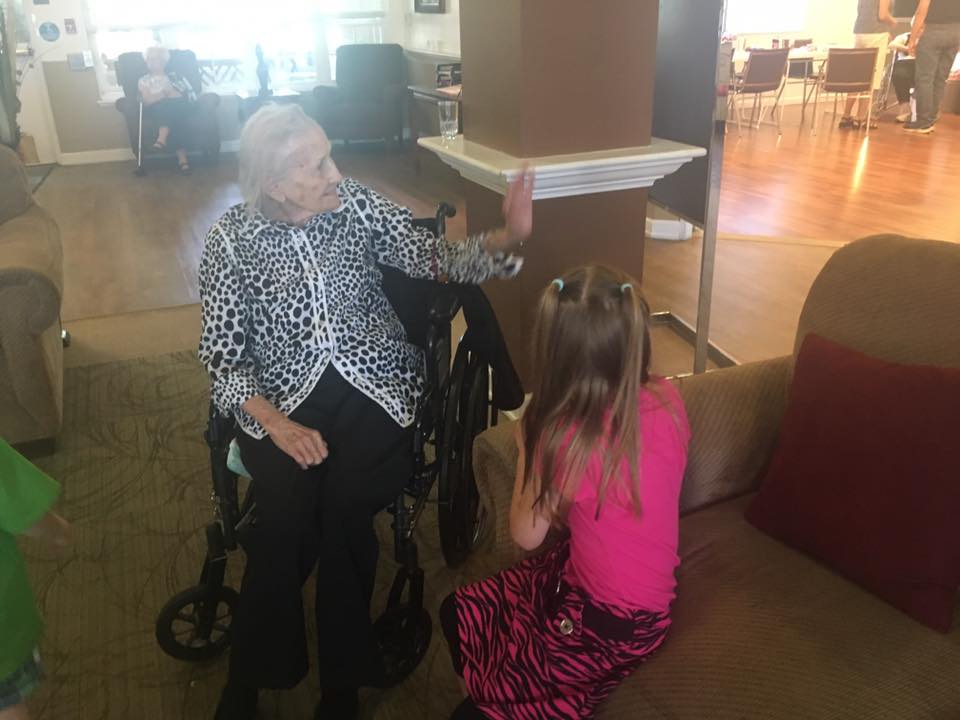
    She had the woman smiling and laughing.  They read a poster together, and then Ashlynn did some OT with her and had her putting her hands in the air and out to the side.

    Ashlynn playing “OT” with the resident.

    At one point I just stared out into the hallway.  I was thinking of how when I went out of my way to be kind and offer company to a person who was lonely, I only did it because I was told to and I wanted someone to be nice to me if Karma ever bit me in the butt….and I’m looking at my own child, who I have never instructed to play with the lonely, and she seeks them out and brings them joy not because she has to or because she was told to….but because she genuinely WANTS to.  You can see, it feeds her soul.

    I will get comments that I am raising her right, but honestly, she teaches me more than I think I teach her.  I was feeling rather uninspired this #apraxiaawarenessday until I saw her at the assisted living facility and I realized….

    Though Ashlynn can now communicate with words, they are still not easy to come. I’m not sure if it is because she has apraxia, but Ashlynn speaks the language of emotion, love, and nonverbal communication.  She is most certainly a healer, seeking out the broken.  She will never make honor roll for this amazing human quality and talent, but it is most certainly a skill most people (like me) would benefit from learning, and she has it naturally.

    I used to use Apraxia Awareness Day to prove how my amazing daughter was because she couldn’t speak for herself.   This 5th Apraxia Awareness Day, I don’t need to prove who Ashlynn is to anyone.  She is quite capable of doing that now all on her own and she still doesn’t need words.  I feel blessed and often unworthy of being her mother.

    As night falls on this 5th Apraxia Awareness Day, which also happens to fall on Mother’s Day, I want the world to simply know Ashlynn is so much more than her apraxia, and I don’t have to prove it anymore.  If you are around her for 5 minutes and are really looking, you will see for yourself.  Before I knew about apraxia I quoted on facebook lyrics from Martina McBride’s song “In My Daughter’s Eyes.”   I had a different frame of reference before apraxia entered my life, but now I realize, apraxia changed nothing.  It’s all still as relevant and true as it was then as it is now.

    As I put Ashlynn and my son Jace to bed tonight I told each of them individually on this Mother’s Day, “Thank you for making me a mom.”

    Happy Mother’s Day AND Apraxia Awareness Day

    In my daughter’s eyes,
    I am a hero,
    I am strong and wise,
    And I know no fear,
    But the truth is plain to see,
    She was sent to rescue me,
    I see who I want to be,
    In my daughter’s eyes
    In my daughter’s eyes,
    Everyone is equal,
    Darkness turns to light,
    And the world is at peace,
    This miracle God gave to me,
    Gives me strength when I am weak,
    I find reason to believe,
    In my daughter’s eyes
    Everyone wore blue for Ashlynn (but Ashlynn).  She did have mismatched socks (pure Ashlynn), and one of them was blue 🙂   Thanks to all of her supporters.
    o   
  • Building Speech and Quantifying Complexity for Apraxia: Interview with creator Kathy J

    Building Speech and Quantifying Complexity for Apraxia: Interview with creator Kathy J

    I’m so honored and excited to have Dr. Kathy Jakielski, Ph.D., CCC-SLP with me today! I met Dr. Jakielski at the CASANA Intensive Training Institute, as she was one of the instructors.

    The honor is all mine, Laura. Thank you for your interest in my work!

    Kathy, I remember vividly this moment at the end of the training, where we all sat around a big conference table, and you gave an impassioned plea. You expressed worry over the future of apraxia, and families having access to quality, research-based intervention. You worried who was going to carry the torch; and as a mother to a child with apraxia, I felt so much gratitude that there were people in this world like you who cared that deeply about a rare speech disorder many have never even heard of.

    When I saw that you had put out your own toolkit, I wasn’t surprised at all to see that you teamed up with CASANA so that proceeds would benefit the non-profit dedicated exclusively to Childhood Apraxia of Speech and their families. Will you tell us what made you decide to dedicate all proceeds to CASANA programs and research?

    Two reasons. The first is because I deeply appreciate CASANA. Before CASANA was founded, parents of children with CAS had to scour articles and conferences to identify researchers experienced with this relatively rare disorder. Parents then would contact us directly via phone and email with their questions. A single correspondence with a parent seeking basic information could take up to an hour, and additional correspondence often was required to answer follow-up questions. There were not enough hours in a week to correspond with all the families seeking information, and I was disheartened that I couldn’t answer more calls. CASANA changed that. From a practical standpoint, they saved me time, while providing families with the information that they needed to make decisions for their children with CAS. Partnering with CASANA on this project was a way to give back to an organization that exists solely to provide and advance education about CAS.

    The second reason, and perhaps the most important one, is because I trust CASANA. I tell parents all the time that they can go to the apraxia-kids website and trust anything they discover and read there. I also knew that they would produce a high-quality product and protect the integrity of my work.

    Please tell my readers a little more about your background and how is it you came to specialize in CAS.

    My initial contact with CAS was when I was working as a clinical speech-language pathologist in private practice. I treated my first child with CAS in 1984, right after I finished my master’s degree program. There was so little information on CAS at that time, but some of the early researchers, Drs. Barbara Davis, Tom Marquardt, and Harvey Sussman, were at my master’s degree institution, so I was able to participate in some of those early studies. But it was by working clinically with several children with this frustrating motor speech disorder that I really came to know and love its challenges. Working clinically for nine years left me with more questions than answers, so I returned to graduate school to pursue my doctoral degree. The work I began in my doctoral program, researching typical and disordered acquisition of speech, as well as differential diagnosis of CAS, are areas of inquiry I continue to study even today.

    You have recently developed and published a new toolkit used to treat CAS. Is this a treatment plan also (and if not, what approach do you use)? What is it and will you please briefly describe it?
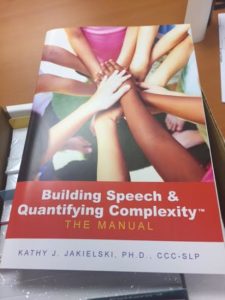
    Building Speech and Quantifying Complexity (BSQC) is a systematic approach for developing therapy goals and selecting words and phrases to target in treatment on a child-by-child basis. It is not a treatment technique, but rather, a phonetics-based approach for deciding what to work on in therapy, but not how to work on it.

    Several therapy techniques (e.g., PROMPT, DTTC, etc.) have been found to be efficacious for how speech-language pathologists can conduct their therapy; however, selecting an evidence-based technique is only one part of clinical practice. Speech-language pathologists also need to be able to select the stimuli that they will target while employing a specific technique. This is the gap that BSQC fills. BSQC is an approach that speech-language pathologists can use to select the goals and stimuli they will target in therapy for children in the early stages of speech intervention. The approach consists of eight speech patterns, or speech frames, and the stimuli that can be used to teach and practice each frame. I have found that many speech-language pathologists do not know how to hierarchically structure the phonetic complexity of speech goals and stimuli for children with severe speech sound disorders, such as CAS. While a speech-language pathologist might be very proficient using various articulatory techniques, if the words targeted are not within the child’s set of motor speech capability, then the child’s progress will be limited and therapy can stall.
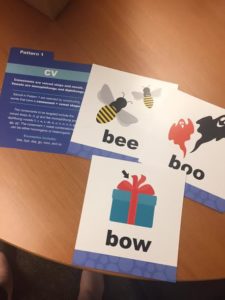
    BSQC serves three primary functions. It is designed to help speech-language pathologists: 1) assess a child’s motor speech complexity over time; 2) develop speech goals that become developmentally and phonetically more complex over time; and 3) develop functional stimuli (words and phrases) to achieve each goal.

    Current research indicates principles of motor learning should drive therapy approaches for CAS. Are principles of motor learning incorporated into BSQC?

    Leave it to a CASANA boot camp graduate to ask that great question! Yes, speech-language pathologists want to consider the principles of motor learning as they conduct intervention using BSQC or any other approach. As previously described, the BSQC toolkit is not a therapy technique, but rather, is used to develop the goals and accompanying stimuli for intervention. Speech-language pathologists need to apply principles of motor learning to the technique they employ. It’s easy to do using BSQC, as there are probably close to 1,000 possible stimuli across the eight speech patterns that speech-language pathologists can use to teach each frame.

    How does your toolkit incorporate current evidence based practice?

    BSQC has grown directly out of the rich research literature on the early acquisition of consonants, vowels, and word shapes produced by typically-developing children in babbling, jargon, and early words. The eight speech frames and accompanying stimuli are based on this body of research, along with some of the cognitive motor learning literature. BSQC also provides speech-language pathologists with a sensitive measure for tracking articulatory progress in speech. This measure, the Index of Phonetic Complexity, has been used in some research for the past 20 years; however, this is the first time I am promoting it for clinical use.

    Can any SLP start using this toolkit or is there some training or manual that is recommended first? Are you offering any workshops or trainings? Finally, is this toolkit appropriate for parents to buy also and use at home?

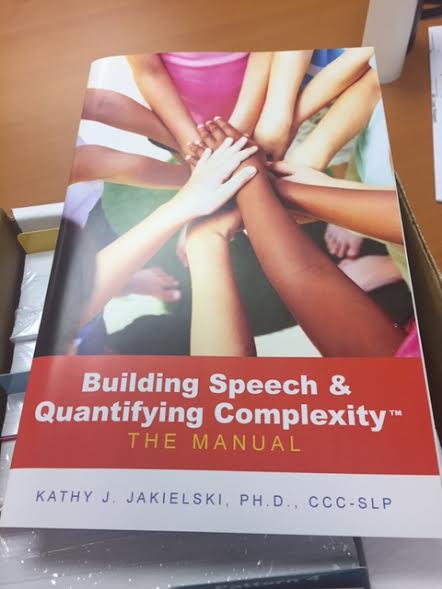
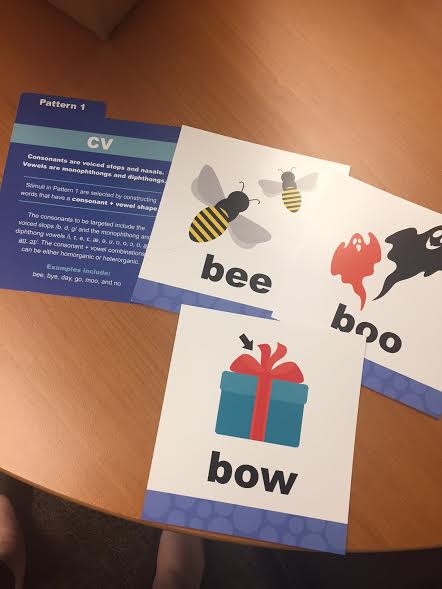
    The toolkit includes a manual that explains the Building Speech materials, which include the goal and stimuli development. The manual also explains the Quantifying Complexity measure, the Index of Phonetic Complexity. In addition to the easy-to-follow manual, there also are close to 800 bright, colorful, child-friendly picture cards depicting many of the words a speech-language pathologist could target using the BSQC approach. The BSQC approach is not appropriate for parents to buy and use at home because of the phonetics background required to understand it, as well as needing to possess knowledge of speech intervention techniques.

    CAS master clinician Lisa Mitchell, M.S., CCC-SLP and I gave a webinar for CASANA on the BSQC approach, which is available for viewing at the apraxia-kids website. I also teach the approach in an online course that’s available through MedBridge, a continuing education company at www.medbridgeeducation.com. In both courses, I explain each step of the approaches, and then you see Lisa putting the approach into action with children on her caseload, which is the real highlight of these presentations.

    Lisa and I also will be teaching the BSQC approach at CASANA’s 2017 Annual Conference on CAS to be held in San Diego, California from July 6-8. Lisa and I will be presenting a pre-conference workshop on Thursday, July 6th. I highly recommend this annual conference to speech-language pathologists and families.

    Therapy for CAS in very individualized due to each child’s unique phonetic and syllabic repertoire, but also should take into account personalized and functional words relevant to each individual child. Can you explain how your toolkit accounts for this?

    I designed the BSQC approach to be individualizable and flexible. There are a myriad of stimuli that can be developed to target each of the eight speech frames, some included in the kit as picture cards, but the key is to determine which words will give a particular child increased communicative power.

    The steps for utilizing the BSQC approach follow.

    1) Phonetically transcribe a representative speech sample from a child and analyze it to determine the child’s phonetic repertoire.

    2) Examine the phonetic repertoire to determine which of the BSQC eight speech frames you need to target, and in which order.

    3) Develop a list of functional words and phrases for that particular child to teach each of the speech frames you decided to target.

    4) Determine the therapy technique you will use in therapy, and incorporate principles of motor learning as you design your sessions.

    5) Use the Index of Phonetic Complexity to quantify incremental progress in speech skills over time. The sensitivity of this measure can help document change that can be used to show progress.

    What sets this toolkit apart from other cards out there marketed toward apraxia?

    This therapy kit provides a unique way of hierarchically ordering speech stimuli based on speech acquisition research. The speech measure, the Index of Phonetic Complexity, purports to measure the phonetic complexity of a child’s speech, which is a very unique feature.

    Thank you for agreeing to offer one today for a giveaway! Where can my readers go to buy this product, and for my International readers, can this product be shipped to other countries?

    Go to www.apraxia-kids.org to place an order. International readers can email CASANA directly for information regarding shipping BSQC to other countries; however, please note that BSQC was developed for American English, and while easily adapted to different dialects of English, it is not intended to be used for languages other than English.

    Kathy, thank you so much for being here! I also can’t thank you enough for all you have done to advance the field of speech/language pathology, especially in the area of Childhood Apraxia of Speech. I’m honored to call you one of my mentors.

    Thank you, Laura, it’s been my pleasure. Thank you for wanting to find out more about BSQC. And thank you, also, for the wonderful clinical, educational, and family work that you offer!

     

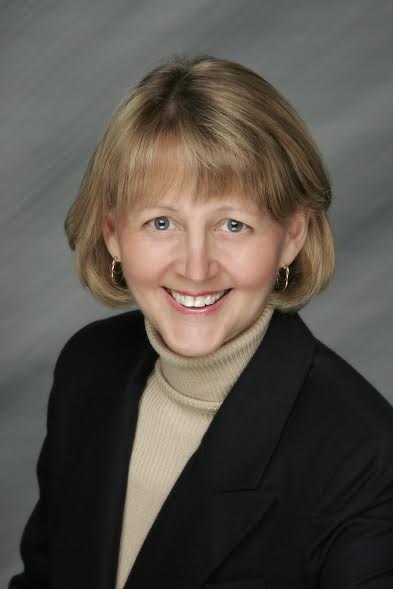
    Kathy J. Jakielski, Ph.D., CCC-SLP is the Florence C. and Dr. John E. Wertz Professor in Liberal Arts and Sciences at Augustana College in Rock Island, Illinois where she serves as Chair of the Department of Communication Sciences and Disorders. She has over 35 years of clinical experience working with children, adolescents, and young adults with severe speech impairment, including CAS. She currently conducts research on genetic bases, differential diagnosis, and intervention efficacy on children with CAS. Teaching the next generation of SLPs and thinking about CAS is what gets her out of bed in the morning.


    Enter the giveaway below!  This is over $175.00 value!  Please note this toolkit is specially designed for SLP’s.  If you are a parent and enter the contest, please give to your child’s SLP!  Thank you!

    *Note – this giveaway is now closed*

    a Rafflecopter giveaway
  • That’s not acceptance, that’s discrimination

    That’s not acceptance, that’s discrimination

    “That’s not acceptance, that’s discrimination.”

    I watched a fellow apraxia mom say this today while she wiped tears from her eyes.  Why?  Well, she was looking at a beautiful newspaper article in the Valley Breeze that she bought special.  She knew it featured her seven year old son who threw out a first pitch along with two other children that day, and couldn’t wait to see his picture and read about it.

    She knew he would be in it, because the paper made a big deal to take his picture, make his mom sign a photo release, and took down some information.  Her son has severe apraxia and dyspraxia, conditions that make it difficult for children to learn how to speak and how  to literally learn every single motor movement, causing significant developmental delays.  Her child has the same condition as MY child.  He has to work about 1000x harder than ANY other kid to learn how to do something others find so easily like talking, running, cutting….and he does through HOURS of therapy.  In many ways, he sacrifices a normal childhood because of all the therapy, so you can imagine how special being in a baseball little league feels to him, even if it is the “challenger league” for kids with disabilities.   Our kids don’t get a lot of “awards” “accolades” or even opportunities to feel good at something.  It’s heartbreaking. They struggle with everything.

    So that’s why throwing out the first pitch alongside two other children was an incredible day and Kendra couldn’t wait to see his smiling face in the paper.

    As she opened it up, her eyes first scanned the pictures.  Her smile and excitement quickly faded to confusion and disbelief.  Where was her son?  There were the two other kids.  The “typical” kids who threw the first pitch alongside him.  In fact, there was not just one but TWO pictures EACH of the children.  Maybe there was some mistake?  Maybe he was on another page? I can imagine her looking at the page before and the page after, yet, Talan was not anywhere to be found.  In fact, though the other little league team was pictured, NOT ONE CHILD from the challenger league was pictured, and THAT my friends is why Kendra came to say,

    “This is not acceptance.  This is discrimination.”

    How is this possible in 2017?  I mean seriously.  It’s not even special treatment to feature Talan.  All Kendra wanted was equal treatment.  Every child who threw a pitch was featured EXCEPT for Talan.  That is not an honest mistake.  This is blatant discrimination.

    Every child, disability or not, is still a child.  They want to feel accepted.  They want to feel proud.  They want to feel included.  They want to have friends.  They feel happiness people and yes, they FEEL sadness too.  The message is clear.  He doesn’t matter as much as the typical kids.  He doesn’t have as much to offer. Despite taking his picture and his information, it wasn’t worthy of being featured.  Oh well, he doesn’t talk right?  He’ll never know.  Oh well, he can’t read, let’s feature the kids who can.  It’s not like Talan will know the difference right?

    “This is not acceptance.  This is discrimination.”

    I write this piece for Kendra, because sometimes it feels like no one cares.  Like our kids don’t matter, so we have to care about each other because if we don’t take care of each other, no one will.  It’s so hard to get people to care, and it’s easy to silence our kids because they didn’t have a voice to start with.

    How screwed up is that?

    “This is not acceptance.  This is discrimination.”

    Letting him throw a first pitch, taking his picture, and writing down his information to NOT feature him alongside his typical peers is egregious.  Valley Breeze, you know what you really missed out on?  A chance to feature a beautiful piece on children of all challenges  playing and living harmoniously.   We aren’t asking for special treatment.  We are just asking to be included and have this world appreciate and include children and people of all walks of life.  This piece would have been the PERFECT opportunity to do so, but instead, the Valley Breeze chose exclusion and discrimination.

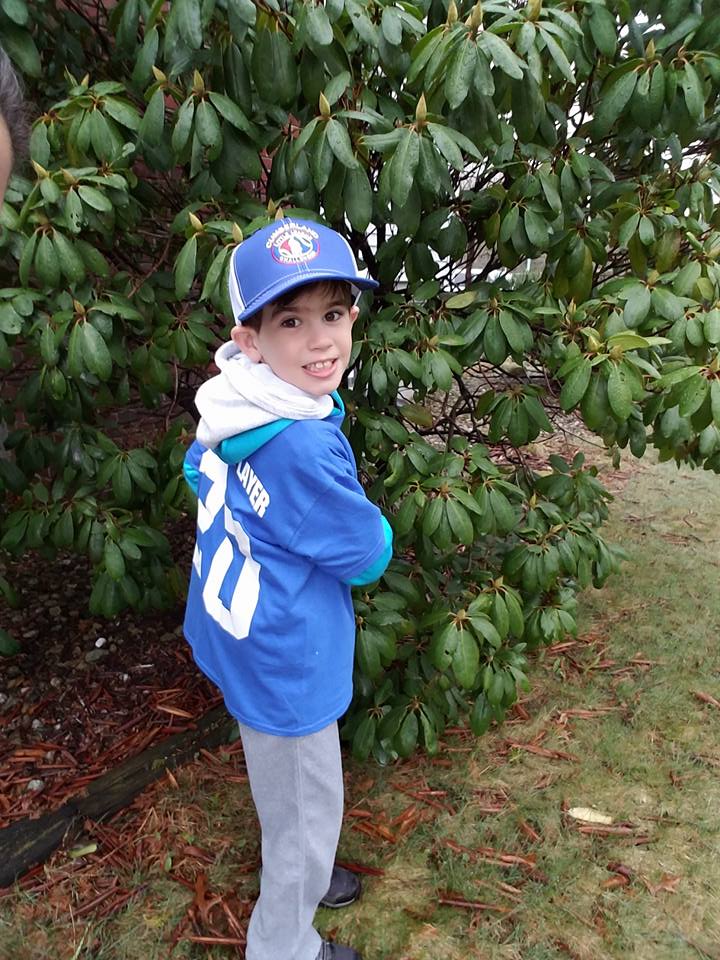
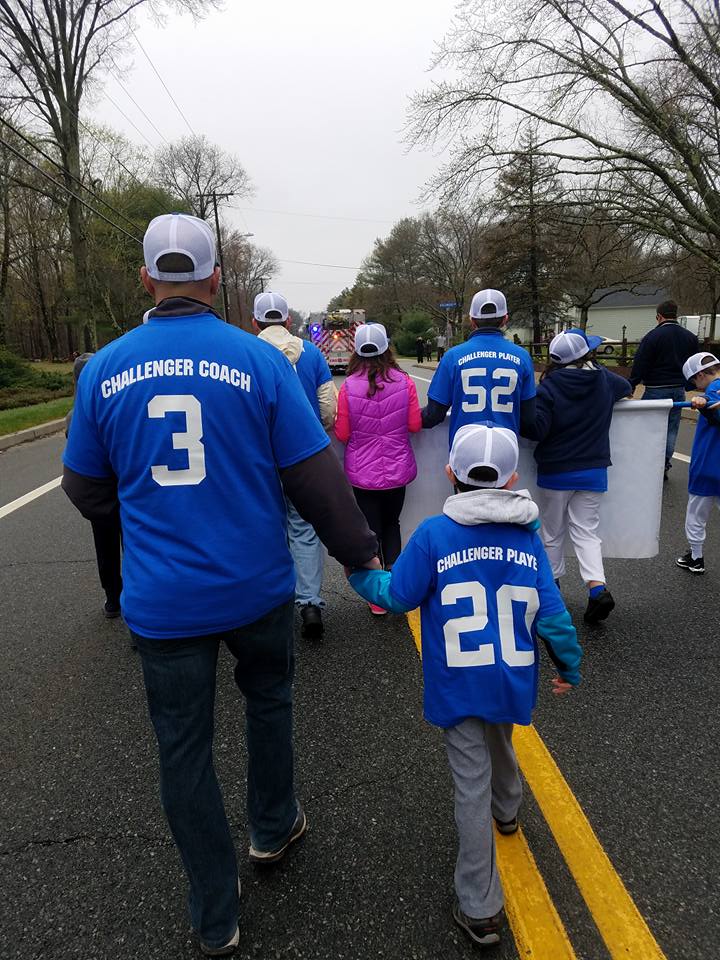
    Shame on them.  So guess what.  I’ll do what the journalist at the Valley Breeze failed to do.  I’ll feature Talan and his teammates on the Challenger League in Cumberland Rhode Island.

    The Challenger League sign is “Never Let the Fear of Striking out Keep you from Playing the Game.”

    Way to go kids and let’s make it a great season!  We see you!  We love you!  We’re cheering for you! Go baseball!


  • Why do we call it “childhood” apraxia of speech?  Isn’t it lifelong?

    Why do we call it “childhood” apraxia of speech? Isn’t it lifelong?

    Ever wonder why CAS is called Childhood Apraxia of Speech? Is it really necessary to have the word “childhood” in there?  Doesn’t it ostracize those who never truly outgrow apraxia?  Plus, isn’t it a lifelong neurological disorder? Why can’t we just call it apraxia, or verbal apraxia? You might be surprised to know the reasoning was more thought out than you might think.

    If you’ve ever had these questions, Sharon Gretz, founder of CASANA, has answers!

    I can speak to this issue from history and experience! When my son was diagnosed at age 3, the “disorder” was called “developmental apraxia of speech”. Over the years of developing parent support and ultimately CASANA, it became clear that many (including insurance companies) interpreted the word “developmental” to mean that a child would outgrow the problem. That all would be well if more time was given for speech development. We all knew that was a bunch of Bull#hi$! These children were not going to “outgrow it”.

    Why is it necessary though to have the term “childhood” in the name?

    When I incorporated CASANA, and with consultation with founding board members Kathy Hennessy and Mary Sturm we decided on the name “Childhood Apraxia of Speech”… So, this term signified that this problem has begun in childhood – at some point of childhood. In most cases, there were no known “causes”, however, a population existed in which we learned children with various neuro-developmental disabilities had apraxia of speech and also children whom had neurological events occur (stroke, injury, illness that caused a brain change). The “Childhood Apraxia of Speech” term was a cover for ALL of those incidents or occurrences in childhood. The more that various researchers heard of the  term, the more they believed that it did in fact – COVER – all children who, for whatever reason, end up with apraxia of speech.

    So why do we use the terms juvenile diabetes, or juvenile arthritis, or childhood leukemia or any number of similar terms? We do that because the same conditions appear in adults, but yet, when they appear in children there are different ramifications that may not appear in the adult onset condition. Knowing this about someone, an adolescent a teenager, for example should mean something to a trained professional. They should understand that the clinical issues and/or appearance of the disorder or difficulty is likely to be different than if that client before them did not experience that same issue in childhood.

    I can also say from a personal perspective that young adults whom have dealt with CAS, call “it” or its remnants whatever they want to call it. Most of them will say apraxia or speech apraxia. It is their prerogative of course! Why would anyone dispute that? And yet, understanding that they “grew up” with apraxia of speech during their formative developmental years, provides a different foundation than to say the young person acquired it as an adult via brain injury, damage, etc.

    I was privileged to be the consumer adviser to the ASHA AdHoc Committee on Apraxia of Speech in children. Their published document began to change things for our kids in a positive direction. For the very first time, children with CAS were recognized as having a specific speech sound disorder which was different than other disorders and that their evaluation and treatment needed to be different. Do you realize this was only 10 years ago??!! Progress seems slow, I know it. But, if you were among those of us who have young adult children, you know that life is much better for you and your children than it had been even 10 years ago!!

    Thank you Sharon for always advocating for our kids, looking out for their best interests, and ensuring a better future for every child who has apraxia!